


Introduction to Ethical Hacking
The demand for cybersecurity professionals has reached an all-time high in 2026. Organizations across India are desperately seeking skilled ethical hacking professionals to protect their digital assets from ever-evolving cyber threats. If you’re searching for an ethical hacking course in Sangam Vihar, you’re not alone.
Students and working professionals increasingly recognize that cybersecurity is no longer a luxury — it’s a necessity. The Indian cybersecurity industry is growing at 30% annually, creating unprecedented opportunities for skilled professionals. But why are students specifically in Sangam Vihar searching for affordable training?
Sangam Vihar’s Strategic Location: Situated in South Delhi, Sangam Vihar offers proximity to India’s growing tech hubs. The area attracts students from nearby regions like Khanpur, Govindpuri, Saket, and Badarpur who seek quality cyber security training without the premium fees charged in central Delhi.
This comprehensive guide covers everything you need to know about ethical hacking course fees in Sangam Vihar, including course duration, syllabus, certifications, placement opportunities, and how to choose the right institute. Whether you’re a BCA graduate, IT professional, or a complete beginner, you’ll find detailed information about training costs and what to expect from your investment.
What is Ethical Hacking?
Ethical hacking is the practice of authorized security testing to identify and fix vulnerabilities in computer systems and networks. Unlike criminal hacking, ethical hacking operates within legal boundaries with explicit permission from system owners.
Definition and Core Concept
An ethical hacker (also called a white-hat hacker) is a certified security professional who uses hacking techniques to test an organization’s security defenses. They simulate real-world cyber attacks to discover weak points before actual cybercriminals can exploit them.
The primary goal of ethical hacking is vulnerability assessment and penetration testing — finding security flaws through authorized testing rather than exploitation. Think of it as a security professional breaking into your house to identify weak locks and broken windows, then providing recommendations to strengthen security.
Role of Ethical Hackers in Cybersecurity
Ethical hackers serve multiple critical functions in modern organizations:
Offensive Security Testing: They conduct penetration testing to simulate real cyber attacks and measure how well an organization’s defenses hold up under pressure.
Vulnerability Identification: Through techniques like network security scanning and code analysis, they identify potential entry points for attackers.
Security Infrastructure Improvement: Their findings lead to enhanced security policies, updated firewalls, and better information security practices.
Compliance and Risk Management: Many regulations require organizations to conduct regular ethical hacking assessments to maintain data protection standards and avoid regulatory penalties.
Legal Hacking vs. Illegal Hacking: What’s the Difference?
Many people ask: “Is ethical hacking legal in India?” The answer is yes, but with important conditions.
Legal Ethical Hacking requires:
- Written authorization from the system owner
- Clear scope defining what can and cannot be tested
- Documented findings and recommendations
- Adherence to confidentiality agreements
Illegal Hacking involves:
- Unauthorized access to computer systems
- Data theft or destruction
- Personal financial gain
- Violation of the Information Technology Act, 2000
In India, illegal hacking can result in imprisonment up to 3 years and fines up to ₹5 lakhs under Section 66 of the IT Act. Ethical hacking, when performed with proper authorization, is completely legal and highly respected.
Importance in Modern Cybersecurity
The importance of ethical hacking cannot be overstated. Consider these statistics:
- Organizations face an average of 2,000+ cyber attacks daily
- Data breaches cost companies an average of ₹20+ crores in losses
- 85% of data breaches could have been prevented with proper security testing
Ethical hackers serve as the first line of defense, identifying threats before they become catastrophic. This proactive approach saves organizations millions in potential losses and protects millions of users’ personal data.
Why Learn Ethical Hacking in Sangam Vihar?
Sangam Vihar has emerged as an educational hub for cybersecurity training. Here’s why this South Delhi area is becoming the preferred destination for learning ethical hacking certification.
Local Demand and Job Opportunities
The Delhi NCR region is home to over 5,000+ IT companies and startups. Sangam Vihar, being in proximity to South Delhi’s tech corridor, offers exceptional cyber security job opportunities. Companies like financial institutions, e-commerce platforms, and IT service providers regularly recruit security professionals from training institutes in this area.
Growing Cybersecurity Jobs in Delhi NCR:
- Security analyst positions have increased by 45% in the last 2 years
- Penetration testing roles are among the highest-paid IT positions
- SOC (Security Operations Center) analyst positions offer ₹4–8 LPA for freshers
Affordable Training Without Compromising Quality
One of the biggest advantages of learning in Sangam Vihar is affordability. While premium institutes in Connaught Place or Nehru Place charge ₹1,50,000+, institutes in Sangam Vihar offer quality ethical hacking training at 40–50% lower costs. You get the same certifications and practical labs at a fraction of the price.
Excellent Connectivity and Accessibility
Sangam Vihar’s location is exceptionally convenient:
- Direct metro access via the Pink Line
- Multiple bus routes connecting to Khanpur, Govindpuri, and Saket
- Easy commute from Badarpur and surrounding South Delhi areas
- Close proximity to Tughlakabad and other residential zones
Delhi NCR Tech Ecosystem Benefits
Being in Delhi NCR provides numerous advantages:
- Access to internship opportunities with major tech companies
- Networking events and cybersecurity conferences
- Proximity to industry experts and guest lecturers
- Connection to bug bounty platforms and real-world hacking challenges
Thriving Cybersecurity Career Path
The cybersecurity field offers exceptional career growth. A fresher can expect to earn ₹3–6 LPA, while a mid-level professional earns ₹8–15 LPA. Experts with specialized skills like digital forensics or red team training command salaries exceeding ₹20 LPA.
Ethical Hacking Course Fees in Sangam Vihar
This is the crucial section for anyone planning to join a course. Understanding the cost structure helps you make an informed decision and find the best value for your investment.
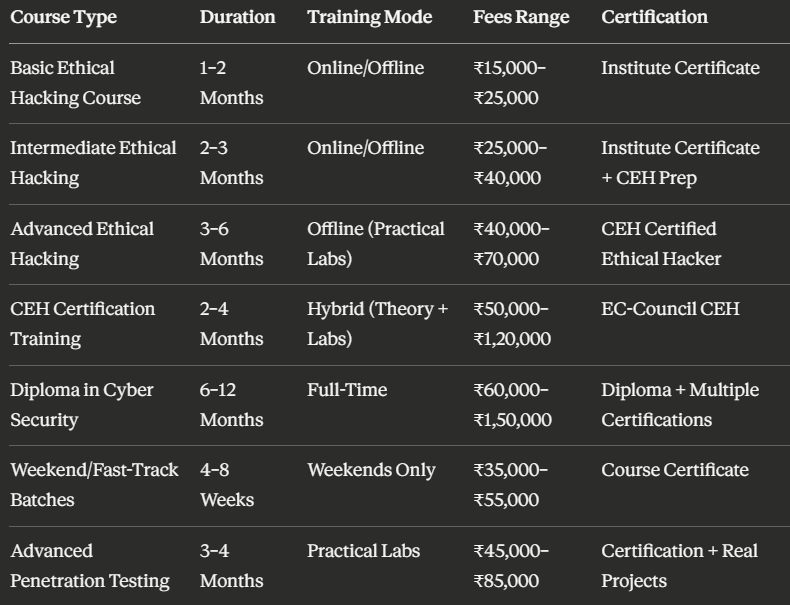
Average Ethical Hacking Course Fees (2026 Rates)
Here’s a detailed breakdown of typical ethical hacking course fees in Sangam Vihar:
Factors Affecting Ethical Hacking Course Fees
Course fees vary significantly based on multiple factors. Understanding these will help you compare institutes effectively.
1. Certification Included or Not
Courses that prepare you for certified ethical hacker certifications cost significantly more. A basic course without CEH preparation might cost ₹20,000, while the same course with CEH exam inclusion can cost ₹80,000+. Global certifications like CompTIA Security+ or OSCP add ₹15,000–30,000 to the total cost.
2. Online vs. Offline Classes
Online ethical hacking training typically costs 20–30% less than offline classes. However, offline training provides hands-on practical labs that are invaluable for learning. Many institutes offer hybrid models at moderate pricing.
3. Lab Access and Practical Environment
Access to practical hacking labs is a major cost factor. Institutes providing:
- Live lab environments with pre-configured vulnerable systems
- Access to Kali Linux with penetration testing tools
- Real penetration testing projects
- 24/7 lab access
These institutes charge ₹10,000–20,000 more than those without dedicated labs.
4. Trainer Experience and Certifications
Trainers with industry experience, active CEH certifications, and experience as penetration testing professionals command higher fees. Expect to pay a premium for trainers who have worked with major organizations or bug bounty platforms.
5. Placement Assistance
Institutes providing dedicated placement assistance add ₹5,000–15,000 to course fees. Some offer a “100% job guarantee” (though verification is important), while others provide standard placement support.
6. Internship Opportunities
Courses including cyber security internship placements cost ₹8,000–12,000 more. However, internships provide real-world experience and often lead to full-time positions.
7. Global Certification Exam Inclusion
If CEH or CompTIA Security+ exam fees are included, expect to pay:
- CEH exam + training: ₹70,000–1,20,000
- CompTIA Security+ exam + training: ₹50,000–90,000
- Multiple certifications bundle: ₹1,00,000–2,00,000
Fee Breakdown Example
Let’s understand a typical 6-month advanced course costing ₹70,000:
- Instructor fees and curriculum development: ₹25,000
- Lab infrastructure and tool licenses: ₹15,000
- Course materials, books, and resources: ₹8,000
- Certification exam fees: ₹12,000
- Placement and alumni support: ₹10,000
Best Ethical Hacking Institutes in Sangam Vihar
Choosing the right institute is as important as choosing the right course. Here’s what to evaluate before joining.
What to Check Before Joining?
Critical Checklist for Institute Selection:
✓ Placement Support: Ask for placement statistics. How many students got placed last year? What was the average salary? Are there MOU agreements with companies?
✓ Practical Labs: Visit the institute and verify they have a dedicated lab. Check if they provide 24/7 lab access. Are tools like Metasploit, Wireshark, and Kali Linux available?
✓ Live Projects: Does the course include real penetration testing projects? Students should work on actual vulnerability assessment cases.
✓ CEH Preparation: If pursuing CEH certification, verify the institute is an official training partner of EC-Council.
✓ Internship Opportunities: Ask about internship placements. Can you intern with organizations they partner with?
✓ Trainer Certifications: Request trainer profiles. They should have active CEH, OSCP, or similar certifications.
✓ Student Reviews and Testimonials: Check Google reviews, testimonials, and social media feedback. Are former students speaking positively about job placements?
✓ Batch Size: Smaller batches (max 20 students) allow better attention and practical training.
✓ Demo Classes: Attend a free demo class to assess teaching quality and course content depth.
✓ Course Documentation: Ask for a detailed syllabus. A well-structured course will have clear modules and learning objectives.
Ethical Hacking Course Syllabus
Understanding what you’ll learn is crucial. Here’s a comprehensive breakdown of typical ethical hacking course topics.
Complete Topics Covered in Ethical Hacking Courses
Modern cybersecurity courses cover diverse technical areas:
Fundamentals and Networking
- Network fundamentals and TCP/IP protocols
- OSI and TCP/IP models
- Network architecture
- Switching and routing basics
Operating Systems and Tools
- Linux and Kali Linux comprehensive training
- Linux administration and security
- Windows security hardening
- Command-line proficiency
Reconnaissance and Information Gathering
- Footprinting techniques
- WHOIS, DNS, and IP address gathering
- Public information reconnaissance
- Social engineering information collection
Active Network Scanning
- Network scanning methodologies
- Scanning techniques and tools
- Port scanning
- Service enumeration
Enumeration and Vulnerability Assessment
- Enumeration of network services
- SNMP enumeration
- NetBIOS enumeration
- Vulnerability assessment techniques
Web Application Security
- Web server security
- Web application security testing
- SQL Injection attacks and prevention
- Cross-Site Scripting (XSS)
- OWASP Top 10 vulnerabilities
Malware and Analysis
- Malware analysis basics
- Malware classification
- Behavioral analysis
- Static and dynamic analysis
Monitoring and Analysis
- Wireshark packet analysis
- Network traffic analysis
- Log analysis and interpretation
- Intrusion detection
Advanced Penetration Testing
- Metasploit framework comprehensive training
- Exploit development
- Post-exploitation techniques
- Privilege escalation
- Penetration testing methodologies
System and Network Hardening
- Password cracking techniques and defense
- Authentication security
- Access control implementation
- Firewall configuration
Specialized Topics
- Cloud security basics and advanced
- IoT security fundamentals
- Mobile security assessment
- Digital forensics introduction
- Incident response basics
Capstone Projects
- End-to-end penetration testing projects
- Real-world scenario simulations
- Bug bounty preparation
- Professional report writing
Certifications Included in Ethical Hacking Courses
Certifications validate your skills and significantly enhance employment prospects. Here’s what you should expect.
Industry-Recognized Certifications
CEH (Certified Ethical Hacker) The most recognized ethical hacking certification, offered by EC-Council. CEH validates your knowledge of penetration testing, vulnerability assessment, and ethical hacking methodologies. Training costs ₹50,000–1,20,000, with exam fees around ₹25,000. CEH professionals earn an average of ₹8–12 LPA.
CompTIA Security+ A vendor-neutral IT security certification recognized globally. It covers cyber security fundamentals, risk management, and security operations. This certification costs ₹40,000–70,000 with exam fees around ₹18,000.
CHFI (Computer Hacking Forensic Investigator) Specializes in digital forensics and incident investigation. Particularly valuable for those interested in forensic analysis careers. Costs typically range from ₹50,000–90,000.
CISSP (Certified Information Systems Security Professional) An advanced certification for experienced security professionals. CISSP courses often include CISSP basics modules. This is a premium certification with exam fees around ₹30,000.
OSCP (Offensive Security Certified Professional) The most hands-on and challenging certification. OSCP basics are sometimes included in advanced courses. It requires 24 hours of continuous penetration testing in an exam environment.
Google Cloud Security Certification Growing in popularity, covers cloud security in the Google Cloud Platform environment. Increasingly offered in modern cyber security courses.
Ethical Hacking Course Duration Options
Different life situations require different training approaches. Here are your options.
Short-Term Courses (4–8 Weeks)
Perfect for professionals with limited time. These intensive programs cover core concepts and basic practical skills. Expect to commit 2–3 hours daily. Cost: ₹20,000–40,000.
Best for: Working professionals, quick upskilling.
Standard Courses (2–3 Months)
The most popular option. Balances comprehensive learning with reasonable time commitment. Includes theory, practical labs, and certification preparation. Cost: ₹30,000–60,000.
Best for: Freshers, transitioning professionals.
Advanced Diploma (6–12 Months)
Full-time or part-time comprehensive programs. Covers advanced topics, multiple certifications, and internship placements. Cost: ₹60,000–1,50,000.
Best for: Career changers, aspiring security architects.
Weekend Batches
Classes held only on weekends, perfect for working professionals. Stretches a 3-month course into 4–5 months. Cost: ₹35,000–55,000.
Best for: Full-time employees seeking upskilling.
Fast-Track Training (4–6 Weeks)
Accelerated programs designed to deliver results quickly. Requires significant daily commitment (6–8 hours). Cost: ₹40,000–70,000.
Best for: Focused learners, those with flexible schedules.
Online Classes with Flexible Timing
Learn at your own pace, any time, anywhere. Typically 6–12 months with lifetime access to course materials. Cost: ₹15,000–45,000.
Best for: Self-disciplined learners, those in remote areas.
Career Opportunities After Ethical Hacking Course
Completing an ethical hacking course opens numerous career doors. The cybersecurity field offers exceptional growth and compensation.
High-Demand Job Roles
Ethical Hacker / Penetration Tester Conduct authorized security testing on organizations’ systems. Identify vulnerabilities and recommend fixes. This is the primary role for course graduates. Average salary: ₹5–10 LPA (entry-level), ₹12–18 LPA (experienced).
Security Operations Center (SOC) Analyst Monitor networks for security incidents in real-time. Analyze security alerts and respond to threats. Often the stepping stone for ethical hackers. Salary: ₹4–8 LPA.
Cyber Security Analyst Comprehensive role covering vulnerability assessment, policy development, and security implementation. Salary: ₹6–12 LPA.
Security Engineer Design and implement security infrastructure. Develop security solutions and protocols. Salary: ₹8–15 LPA.
Incident Responder Investigate security breaches and manage crisis response. Handle digital forensics and evidence collection. Salary: ₹8–14 LPA.
Vulnerability Assessment Specialist Focus exclusively on finding and documenting vulnerabilities. Work with vulnerability assessment tools and methodologies. Salary: ₹5–10 LPA.
Salary Growth in India (2026 Data)
Here’s realistic salary progression in Indian cybersecurity roles:
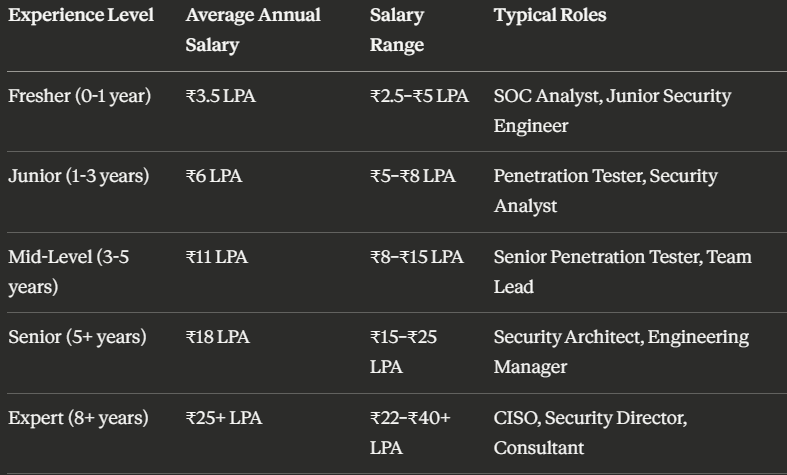
Important Note: Salary depends on skills, certifications (especially CEH), organization type (startups vs. enterprises), and location. Certifications like OSCP can increase salaries by 20–30%.
Online vs. Offline Ethical Hacking Training
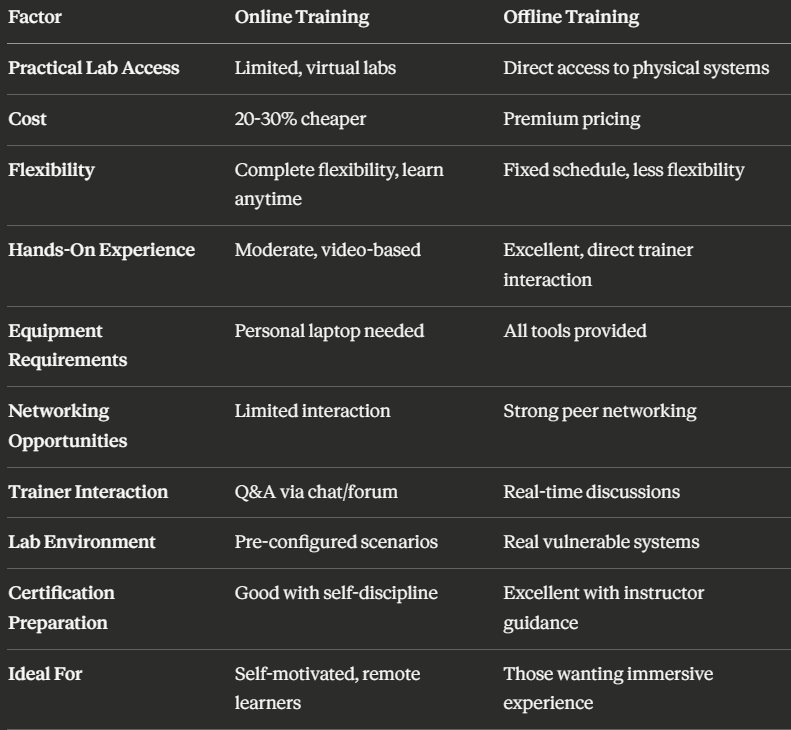
Choosing between online and offline training is a major decision. Let’s compare them objectively.
Detailed Comparison
Which Should You Choose?
Choose Online If You:
- Work full-time and need flexibility
- Have good self-discipline
- Prefer learning at your own pace
- Have limited budget
- Live far from training centers
Choose Offline If You:
- Want hands-on practical experience
- Benefit from direct instruction
- Need networking opportunities
- Want immediate doubt resolution
- Are willing to invest more
Hybrid Approach (Recommended for Best Results): Many institutes now offer hybrid models — online theory with weekend practical labs. This provides flexibility with practical experience. Cost: ₹40,000–70,000.
Who Should Join an Ethical Hacking Course?
Ethical hacking training is suitable for diverse professionals. Let’s identify who benefits most.
Target Audience and Ideal Candidates
BCA/MCA/B.Tech Students Fresh graduates seeking specialized skills beyond their degree. Perfect timing before entering the job market. Average course cost: ₹30,000–50,000.
IT Professionals (1–5 years experience) System administrators, network engineers, and support staff looking for career advancement. Security roles offer better compensation and growth. Average course cost: ₹40,000–70,000.
Working Professionals in Other Fields Career changers recognizing cybersecurity’s growth potential. Finance, government, and healthcare professionals often transition to security roles. Average course cost: ₹50,000–80,000.
Complete Beginners No prior IT experience? Many institutes offer foundation modules. You’ll need strong dedication but can absolutely succeed. Average course cost: ₹30,000–60,000.
Entrepreneurs and Business Owners Understand security threats to your business. Many business owners now pursue CEH to protect their ventures. Average course cost: ₹60,000–1,00,000.
Government and Defense Personnel India’s defense and intelligence agencies increasingly recruit certified security professionals. Specialized training available. Average course cost: ₹50,000–90,000.
Success Factors for Course Completion
Successful students typically:
- Commit 2–3 hours daily to learning
- Complete hands-on lab exercises
- Practice with Metasploit and Kali Linux regularly
- Engage with practical projects
- Maintain consistent effort for 2–6 months
How to Choose the Best Ethical Hacking Institute in Sangam Vihar
Making the right choice requires careful evaluation. Here’s your step-by-step guide.
Comprehensive Institute Evaluation Checklist
Step 1: Verify Institute Credentials
- Is the institute registered and officially recognized?
- Are they official training partners of EC-Council (for CEH)?
- Do they have government certifications (ISO, ISO 27001)?
- How long have they been operating? (Prefer 3+ years)
Step 2: Evaluate Faculty Quality
- Request trainer profiles with certifications
- Check if trainers have industry experience
- Are trainers actively working in cybersecurity? (Part-time trainers from industry are often best)
- Do they have published research or bug bounty achievements?
Step 3: Assess Lab Infrastructure
- Visit the lab in person if possible
- Check the number of systems available
- Verify Kali Linux and hacking tools are installed
- Ask about lab access hours (24/7 access is excellent)
- Check if they provide VMs for home practice
Step 4: Review Course Curriculum
- Compare with industry standards
- Ensure coverage of penetration testing, network security, and web application security
- Check if advanced topics like cloud security and digital forensics are included
- Verify practical projects are included
Step 5: Check Placement Records
- Ask for placement statistics (% of students placed)
- Request for employer list and partner companies
- Inquire about average package offered
- Ask about placement assistance duration (usually 1–2 years post-course)
Step 6: Review Cost Transparency
- Get detailed fee breakdown (no hidden charges)
- Ask if material costs are included
- Clarify if exam fees are included
- Ask about refund policies
- Inquire about EMI or installment options
Step 7: Attend Demo Classes
- Most institutes offer free demo classes
- Assess teaching quality and pace
- Interact with current students
- Ask questions about curriculum and placements
- Evaluate if teaching style matches your learning preference
Step 8: Read Reviews and Testimonials
- Check Google Reviews for recent feedback
- Look at Facebook and LinkedIn reviews
- Contact alumni directly for honest feedback
- Verify reviews mention job placements
- Be cautious of extremely positive reviews (may be fake)
Step 9: Verify Certification Validity
- Confirm certifications are globally recognized
- Check CEH certificates on EC-Council registry
- Verify CompTIA certifications on CompTIA website
- Ensure certifications have no expiry (or long validity)
Step 10: Make Final Comparison
- Create a spreadsheet comparing 3–5 institutes
- Score them on: Faculty quality, Lab infrastructure, Placement record, Cost, Location
- Weight factors by importance
- Make a data-driven decision
Red Flags to Avoid
🚩 “100% job guarantee” with no verification mechanism
🚩 Unusually low fees compared to competitors (often indicates low quality)
🚩 No information about trainer backgrounds
🚩 No lab facility or “online-only” when hands-on training is required
🚩 No placement assistance mentioned
🚩 Recent poor reviews on Google
🚩 Pressure to pay full fees upfront
🚩 No curriculum transparency or refusal to share syllabus
🚩 Claims of guaranteeing specific certification without standardized exams
FAQs About Ethical Hacking Course Fees in Sangam Vihar
People frequently ask numerous questions about costs, certifications, and course structure. Here are detailed answers.
Q1: What is the average cost of an ethical hacking course in Sangam Vihar?
The average cost ranges from ₹25,000 to ₹70,000 for standard courses (2–6 months). Basic courses start at ₹15,000, while advanced diplomas with multiple certifications can cost ₹1,00,000–1,50,000. The variation depends on course duration, certifications included, and practical lab access.
Q2: Are there any institutes offering ethical hacking training under ₹15,000 in Sangam Vihar?
Yes, some institutes offer basic courses under ₹15,000, but carefully evaluate what’s included. Very low-cost courses typically don’t include practical labs, certification exam fees, or proper placement support. A quality course with practical training usually costs ₹25,000+.
Q3: Do the course fees include the cost of global certification exams like CEH?
It depends. Some institutes include certification exam fees in their course cost (transparent pricing). Others charge separately. For example, a course might cost ₹70,000 with CEH exam included (total ₹70,000), while another charges ₹50,000 + ₹20,000 exam fees separately. Always ask for this clarification upfront.
Q4: Is there a monthly installment (EMI) option available for the fees?
Many institutes offer EMI options. You can typically pay in 3–6 monthly installments with 0–5% processing charges. Some offer interest-free EMI for HDFC, ICICI, and other bank credit cards. Ask about EMI at enrollment.
Q5: Are there any institutes in Sangam Vihar offering a “pay after placement” model?
A few institutes offer this, but verify carefully. The terms usually state: “Pay full course fees after securing a job paying at least ₹3–5 LPA.” Ensure this doesn’t trap you if you find a lower-paying position. Most students prefer upfront payment with placement assistance over uncertain payment models.
Q6: Does the fee change for weekend batches versus weekday batches?
Weekend batches often cost 10–15% more due to higher operational costs (premium time slots). A weekday batch costing ₹40,000 might be ₹45,000–48,000 on weekends. However, the difference isn’t significant enough to be a major decision factor.
Q7: Is there a discount on fees for students or early bird registrations?
Most institutes offer:
- 10–15% student discount (with valid ID)
- 5–10% early bird discount (first 10–20 enrollments)
- 5% sibling/group discount
- Loyalty discounts for alumni referrals These can reduce your total cost by ₹3,000–8,000.
Q8: Are lab charges and study materials included in the quoted course fee?
Clarify this at enrollment. Premium institutes include everything (lab, materials, tools). Some charge separately:
- Lab charges: ₹3,000–5,000 extra
- Study materials: ₹2,000–4,000 extra
- Certification exam: ₹10,000–25,000 extra A transparent institute states all costs upfront.
Q9: How much extra do I need to pay for advanced modules like Penetration Testing or Forensic Investigation?
Most institutes include advanced modules in the base course. However, specialized add-on modules cost ₹5,000–15,000 extra:
- Advanced Penetration Testing (OSCP prep): ₹10,000–15,000
- Digital Forensics advanced: ₹8,000–12,000
- Cloud security advanced: ₹6,000–10,000
- Specialized tool training: ₹3,000–8,000
Q10: Do local institutes provide a free demo class before paying the admission fee?
Excellent institutes always offer free demo classes. This is your chance to:
- Assess teaching quality
- Confirm curriculum depth
- Meet current students
- Clarify fee structure
- Evaluate if the learning environment suits you
Always attend a demo before deciding. If an institute refuses a demo, it’s a red flag.
Q11: What is the fee difference between a basic 1-month course and a 6-month diploma?
Basic 1-month: ₹15,000–25,000 6-month diploma: ₹60,000–1,50,000
The 6-month diploma includes:
- More comprehensive curriculum
- Multiple certifications
- Hands-on projects
- Internship placement
- Better job placement prospects
While the diploma costs 3–5x more, the career returns (₹10+ LPA vs ₹3–4 LPA for basics) justify the investment.
Q12: Is the fee for online classes lower than physical classroom training in Sangam Vihar?
Yes, typically 20–30% lower. Online courses cost ₹15,000–40,000, while offline costs ₹25,000–70,000. However, offline training provides better practical exposure and networking opportunities. Hybrid training (online theory + weekend labs) offers the best balance at ₹40,000–60,000.
Q13: Are there any government-recognized institutes in the area with subsidized fees?
Some government training centers and skill development institutes offer subsidized courses (₹5,000–10,000), but they’re highly competitive with limited seats. Private institutes in Sangam Vihar offer better infrastructure and placement support despite higher costs.
Q14: Does the course fee cover a 100% job guarantee or just placement assistance?
Most institutes offer “placement assistance” (not guarantee). This includes:
- Interview preparation
- Resume review
- Job interviews with partner companies
- Internship opportunities
True “100% job guarantee” is rare. Verify what institute means when they claim guarantees — some require minimum qualification or CGPA.
Q15: Is there a registration or admission fee separate from the tuition fee?
Some institutes charge 10–20% of course fees as non-refundable registration fees. This covers:
- Enrollment processing
- ID card creation
- Library access
- First-month lab fees
Transparent institutes include this in quoted fees. Always ask for the final all-inclusive cost.
Q16: Can I get a refund if I decide to discontinue the course after the first week?
Most institutes offer:
- 100% refund within 7–14 days of enrollment (minus registration fee)
- 50% refund after 1 month
- No refund after 50% course completion
- Some offer no refund policy
Always read the refund policy carefully before enrolling.
Q17: Do institutes charge extra for providing hands-on training on specific hacking tools?
No legitimate institute should charge extra for core tools taught in the course. However, specialized tool training (advanced Metasploit, Wireshark certification, or specific frameworks) might have small additional charges (₹2,000–5,000).
Q18: Are there any hidden charges like library fees or software installation costs?
Transparent institutes have no hidden charges. However, some charge:
- Library membership: ₹1,000–2,000 annually
- Software licenses: ₹500–1,500 (if needed)
- Exam retake: ₹5,000–8,000
- Transcript issuance: ₹500
Always ask for a detailed fee breakdown to avoid surprises.
Q19: Does the fee include a certificate of completion from the local institute?
Yes, all institutes provide completion certificates. Additionally, you receive:
- Institute course completion certificate
- Official CEH certification (if CEH training)
- CompTIA digital badge
- Linkedin-verified certifications
Ensure the institute’s certificates are professionally printed and include security features.
Q20: How do the ethical hacking course fees in Sangam Vihar compare to institutes in nearby Saket or Nehru Place?
Sangam Vihar offers excellent value compared to nearby areas:
- Sangam Vihar: ₹30,000–70,000 (average)
- Saket: ₹40,000–80,000 (15–20% higher)
- Nehru Place: ₹50,000–1,20,000 (premium pricing)
- Connaught Place: ₹60,000–1,50,000 (highest prices)
Sangam Vihar provides 30–40% cost savings while maintaining comparable quality, making it South Delhi’s most economical option for cybersecurity training.
Why Choose Sangam Vihar for Your Ethical Hacking Training?
Sangam Vihar has become synonymous with affordable, quality ethical hacking training in South Delhi. Here’s why:
Unique Advantages of the Area
Economic Value: You get world-class cybersecurity training at 40% lower costs than central Delhi while maintaining the same certification standards and industry recognition.
Perfect Location: The area’s connectivity via metro and buses makes it accessible from Khanpur, Govindpuri, Badarpur, Tughlakabad, and across South Delhi without major commute hassles.
Emerging Tech Hub: Sangam Vihar is witnessing rapid growth with new IT companies and startups establishing operations, creating abundant internship and placement opportunities.
Quality Education: Institutes here compete on quality while maintaining affordability, forcing continuous improvement in curriculum and faculty quality.
Community Support: A growing cybersecurity professional community in the area means networking opportunities and knowledge-sharing forums.
Final Conclusion
Investing in an ethical hacking course in Sangam Vihar is investing in your future. The cybersecurity field offers unparalleled career growth, exceptional salary progression, and job security in India’s booming tech sector.




 English