

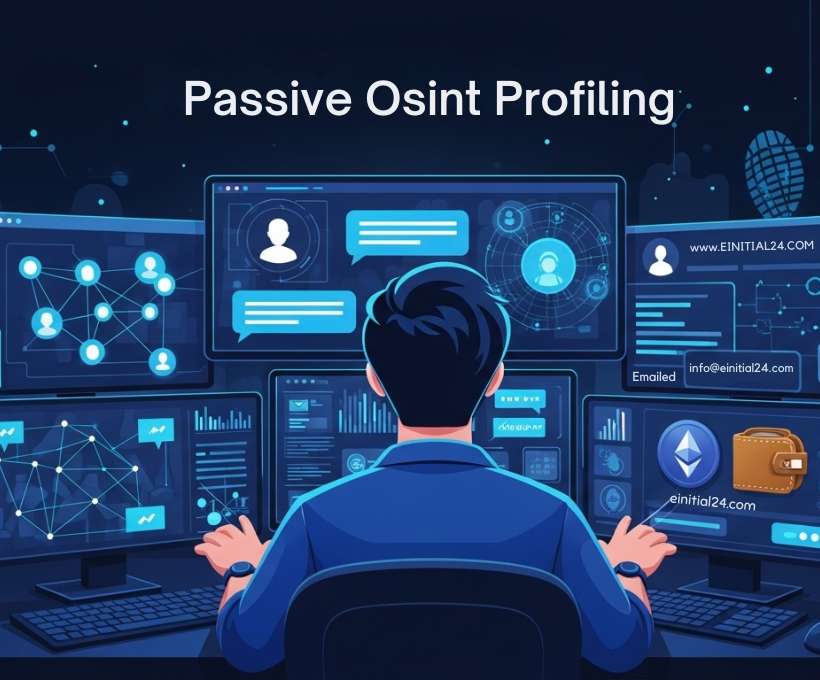
Cybercrime has become more organized, more deceptive, and more difficult to track than ever before. Attackers no longer rely only on obvious technical exploits. They hide behind aliases, encrypted messengers, disposable emails, fake storefronts, and layers of digital identity. Yet even in this environment, people still leave traces.
That is where passive OSINT becomes valuable.
Passive OSINT, or passive open-source intelligence, is the practice of gathering and analyzing publicly available information without directly interacting with the target. In cybercrime investigations, this approach helps analysts understand patterns, relationships, preferences, infrastructure, and behavior without tipping off the subject. It is quiet, careful, and often surprisingly powerful.
This article explains how passive OSINT can be used for OSINT profiling, especially when studying cybercriminals. It also covers practical methods such as username analysis, writing style comparison, PGP key inspection, email intelligence, Discord and Telegram mapping, and cryptocurrency observation. If your team needs stronger investigative capability, better analyst training, or custom OSINT products, EINITIAL24 can support training, services, and product development tailored to real-world threat intelligence needs.
What Is Passive OSINT?
Passive OSINT means collecting intelligence from sources that are already public, indexed, archived, or otherwise openly accessible. It does not involve logging into private accounts, deploying malware, bypassing access controls, or directly contacting the target. Instead, it focuses on what is already visible.
In cybercrime work, that can include forum handles, social media traces, domain registrations, leaked metadata, encrypted messaging footprints, marketplace behavior, public blockchain activity, and even writing habits. Each fragment may seem small on its own. But when assembled correctly, they create a profile.
That profile can reveal whether the same actor is reusing identities, whether a group is linked across platforms, whether a marketplace seller is trustworthy or fraudulent, and whether different incidents may be connected to the same threat actor.
Passive OSINT is especially useful because it reduces operational risk. It helps investigators learn without escalating the situation. It also supports evidence preservation, strategic decision-making, and long-term monitoring.
How Passive OSINT Works for You
Passive OSINT works because human behavior is hard to hide completely. Even cybercriminals who try to appear anonymous often repeat themselves. They reuse usernames. They favor certain phrasing. They keep similar posting schedules. They promote the same services. They leave wallet trails. They join the same Telegram communities. They reference the same language, slang, or technical habits.
The goal is not to “unmask” someone recklessly. The goal is to build confidence around attribution, linkage, and behavioral pattern analysis.
A strong passive OSINT workflow usually starts with one anchor point. That anchor could be a username, an email address, a Bitcoin wallet, a Telegram handle, a marketplace alias, or a suspicious domain. From there, the analyst expands outward through public context. The more correlations that appear, the stronger the profile becomes.
This approach is useful for security teams, fraud investigators, brand protection specialists, law enforcement support units, journalists, and threat intelligence analysts. It is also valuable for organizations that need to understand how threat actors advertise access, recruit affiliates, or monetize stolen data.
Passive OSINT and Cybercrime
Cybercriminals depend on identity management just as much as legitimate businesses do. They build reputations, advertise services, negotiate prices, and create trust in illicit ecosystems. They may use different handles for different purposes, but the underlying patterns often persist.
A ransomware affiliate may post in Russian-speaking forums with a certain style. A phishing operator may reuse a template for pages and email signatures. A carding seller may use the same crypto wallet across multiple listings. A malware developer may promote the same toolset under several personas. These overlaps are where passive OSINT becomes useful.
The most effective profiling does not rely on one signal. It relies on many weak signals that reinforce each other. For example, a username might match across two forums. The same phrasing might show up in both profiles. The same PGP key fingerprint may be attached to both. The same Telegram contact may appear in both biographies. None of these alone proves identity. Together, they can be significant.
That is why profiling is a discipline, not a guess. It requires patience, structure, and restraint.
OSINT Profiling: Passive OSINT Methods for Fighting Cybercrime
Profiling cybercriminals with passive OSINT is best approached as an evidence-building process. Below are the most useful methods.
Username Analysis
Usernames are often the first and easiest clue.
Cybercriminals frequently recycle handles across forums, marketplaces, social platforms, and messaging apps. Even if they modify the handle slightly, the core pattern may remain. You may see the same root name, the same number sequence, or a similar naming habit.
Username analysis is valuable because people like consistency. They build brand recognition, even in illegal ecosystems. A seller who wants repeat buyers may keep the same alias. A group member who wants recognition may use a familiar style. Even when the username changes, the structure may not.
A good analyst looks beyond exact matches. They examine partial overlaps, naming conventions, punctuation habits, and linguistic quirks. A handle that appears in both a breach forum and a Telegram channel may be enough to establish a meaningful link when combined with other evidence.
This kind of correlation is especially useful in attribution support and in mapping actor ecosystems.
Writing Style and Language Patterns
Language is one of the most underrated OSINT signals.
People write in habits. They make repeated grammar mistakes. They prefer certain words. They use specific punctuation. Some are terse and technical. Others are verbose, promotional, or aggressive. Some mix languages. Some use machine translation in a recognizable way. Some overuse phrases like “fast delivery,” “trusted,” “vouched,” or “no refund” in suspiciously similar ways.
In cybercrime profiling, writing style can help connect a forum seller, a Telegram operator, and a marketplace vendor who may be the same person or closely related actors.
The goal is not to do literary forensics in isolation. It is to identify recurring markers that can be compared across public posts, advertisements, comments, and profile descriptions. Tone, formatting, spelling errors, sentence rhythm, and vocabulary all matter.
This method works particularly well when combined with username correlation and time-zone analysis. If the same phrase appears across multiple platforms at similar times, the confidence increases.
Products and Services
What cybercriminals sell often says as much as how they speak.
Threat actors advertise products and services such as phishing kits, malware, bot access, account takeovers, stolen credentials, RDP access, cracked tools, fake documents, or “verification” services. The way they present these offerings can reveal specialization, target region, pricing structure, and credibility.
A seller’s product descriptions may repeat across platforms. They may use identical bullet points, the same screenshots, or the same contact method. They may mention support windows, refund conditions, or delivery times that match other listings. They may also bundle services in a way that reveals an operational model.
For example, someone advertising both initial access and ransomware negotiation support may be part of a wider criminal service chain. Another actor repeatedly selling the same phishing kit may be operating a low-level commercialized tool business rather than a sophisticated intrusion team.
Passive OSINT helps separate hype from reality. It allows analysts to compare claims against visible history. That can help determine whether an actor is new, established, opportunistic, or part of a larger network.
PGP Keys
PGP keys are common in underground forums and privacy-focused environments. They are often used for secure communication and for proving continuity of identity over time.
From a passive OSINT perspective, PGP keys can be useful because they create linkable artifacts. A public key may be posted in a profile, a signature block, a forum thread, or an archived advertisement. If that same key appears elsewhere, it can support attribution or at least strong association.
Analysts may look at the key itself, its fingerprint, the date it was created, the associated name string, and where it appears. Reuse is especially important. Cybercriminals who rely on reputation often keep a key active for a long time. When they switch handles but keep the same key, the link can become obvious.
PGP analysis must be handled carefully. It is best used as part of a broader profile, not as a standalone conclusion. Still, when paired with other signals, it can be highly persuasive.
Email Addresses
Email addresses remain one of the most useful intelligence anchors in passive OSINT.
They can appear in data leaks, forum registrations, marketplace profiles, malware logs, breach dumps, and public paste sites. Even if an email is not directly tied to a legal identity, it may connect to a larger network of accounts, domains, usernames, or communications.
Analysts can compare patterns in the local part of the address, the domain used, the registration style, and the services tied to it. Disposable emails, privacy-focused email providers, and reuse patterns can all offer clues.
A single email address may also correlate with usernames on different platforms. Sometimes the same local part is used across gaming accounts, social accounts, and underground identities. Other times the email is forwarded, masked, or linked to a specific domain created for fraud or phishing.
The key is not to overclaim. Email intelligence is powerful because it is connective. It often shows relationships rather than identity by itself.
Discord and Telegram
Discord and Telegram have become important channels for cybercriminal communication, coordination, recruitment, and customer support.
Passive OSINT on these platforms focuses on what is public or semi-public. That can include visible usernames, channel names, group descriptions, invite patterns, profile bios, public messages, linked websites, shared files, and reposted announcements.
Telegram, in particular, is often used for distribution and market signaling. Actors may post updates, advertise access, or push traffic to mirrored channels. Discord may be used for community building, private group access, or support-style interaction.
A good profile may connect a Telegram handle to a forum alias, a website, or a crypto wallet. It may also reveal timing patterns, language consistency, and affiliate relationships.
These platforms are dynamic, so archival capture and documentation matter. Public posts can disappear quickly, but the intelligence value often remains in screenshots, metadata, and linked references.
Cryptocurrency
Cryptocurrency is one of the most important passive OSINT domains in cybercrime profiling.
Many illicit actors use crypto to receive payment, move funds, or obscure transaction flow. Yet blockchain activity is not invisible. Public blockchains leave records. Wallet addresses can be traced, clustered, and compared with other open-source signals.
A wallet may be reused in forum signatures, market listings, donation pages, scam posts, or service advertisements. That reuse is often more valuable than the transaction history alone. If the same wallet appears on multiple platforms, the actor’s ecosystem becomes easier to map.
Crypto analysis can also show operational patterns. The timing of wallet activity may align with service promotions. Payment addresses may be rotated in a predictable manner. Some actors reuse addresses despite claiming not to. Others rely on a small number of intermediaries, which can create visible patterns.
Passive cryptocurrency analysis is not about guessing ownership from one transfer. It is about pattern recognition, wallet association, and contextual corroboration. It works best when combined with usernames, messaging handles, domains, and forum identities.
Want to See These Tips and Tricks in Action?
The theory becomes much more useful when it is applied to real investigations.
A good OSINT profiling process begins with a simple question: what public signals can be connected without interacting with the target? From there, analysts can build a timeline, a relationship map, and a confidence framework.
At EINITIAL24, we help organizations turn passive intelligence into practical capability. That includes OSINT training, cyber threat analysis services, and product development for teams that need repeatable workflows, automated intelligence gathering, or custom investigation support. Whether your team is building an internal threat intelligence function or strengthening fraud and cybercrime research, EINITIAL24 can help convert scattered signals into actionable insight.
FAQs: OSINT Profiling
Q: What is Passive OSINT in the context of cybercrime investigation?
Passive OSINT is the collection of publicly available information without directly engaging with the target. In cybercrime investigation, it is used to identify patterns, aliases, infrastructure, communication habits, and public traces that help build a profile.
Q: How does passive OSINT help understand cybercriminals?
It helps analysts see the actor behind the behavior. Cybercriminals often reuse usernames, language patterns, wallets, contact methods, and platforms. Passive OSINT links those fragments into a broader picture.
Q: What is the difference between active and passive OSINT?
Passive OSINT relies on publicly available sources and does not interact with the target. Active OSINT involves direct interaction, such as logging into restricted spaces, sending messages, or using probes. Passive methods are usually safer and lower risk.
Q: What are the best passive OSINT methods for profiling criminals on the dark web?
The strongest methods include username correlation, writing style analysis, PGP key comparison, email linkage, Telegram and Discord observation, and cryptocurrency tracing. The key is to combine multiple weak signals into a single evidence chain.
Q: How can I trace a cybercriminal’s cryptocurrency wallet?
Start by identifying public wallet addresses tied to forum posts, advertisements, donation links, or scam pages. Then compare transaction patterns, reuse behavior, and associated public identities. Blockchain explorers and threat intelligence context help, but no single transaction should be treated as proof of ownership.
Q: What is “Username Correlation” and why is it effective?
Username correlation is the process of linking the same or similar usernames across different platforms. It works because many people reuse handles, naming structures, or partial variants of the same identity. In cybercrime, that repetition can expose connections between accounts, services, and marketplaces.
Q: What tools are used for passive OSINT investigation?
Common tools include search engines, archived web content, breach intelligence sources, blockchain explorers, social platform search features, domain intelligence tools, public record sources, and threat intelligence platforms. The best results come from using multiple sources together, not relying on one tool.
Q: Is it safe to investigate cybercriminals? How do I protect myself?
It can be risky if done carelessly. Passive methods are safer than active engagement, but investigators should still use secure work environments, separate identities, strong compartmentalization, logging discipline, and organizational approval. High-risk cases should follow legal and security procedures.
Q: How can I identify a fake URL used by scammers?
Look for spelling changes, unusual subdomains, mismatched branding, suspicious character substitution, missing HTTPS trust indicators, recently registered domains, and links shared through unusual channels. Scammers often copy a legitimate brand but change small details to fool users.
Q: Is using passive OSINT legal?
In many contexts, yes, because it relies on publicly available information. However, legality depends on jurisdiction, data handling practices, terms of service, and how the information is used. Always follow local law, organizational policy, and ethical standards.
Q: What should be done with the findings?
Findings should be documented, validated, and handed off through the proper channel. That may mean internal security teams, fraud teams, legal counsel, law enforcement, or threat intelligence platforms. The purpose is to support action, not speculation.
Why Passive OSINT Matters Now
Cybercrime is no longer isolated or amateurish. It is commercial, distributed, and adaptive. Investigators need methods that are rigorous without being reckless. Passive OSINT fits that need because it supports intelligence collection while reducing direct exposure.
It is also scalable. A strong process can be repeated across cases. It can be taught to analysts. It can be supported by workflow tools. It can be improved with automation and structured data handling. That is where capability building matters most.
Organizations that invest in OSINT maturity gain a practical advantage. They can respond faster, understand actor ecosystems more clearly, and make more informed decisions during investigations, incident response, and fraud analysis.
Building a Strong OSINT Practice with EINITIAL24
If your goal is to move beyond ad hoc research and build a real OSINT capability, EINITIAL24 can help.
Our focus includes training, investigative services, and product development for teams that need dependable intelligence workflows. That may include analyst upskilling, profiling frameworks, OSINT process design, reporting structures, or custom tooling for cyber threat research and monitoring.
The advantage of working with a dedicated partner is consistency. Instead of piecing together scattered methods, your team gets a structured approach that fits real operations. That matters whether you are building a fraud response workflow, a threat actor profiling process, or a broader intelligence function.
Final Thoughts
Passive OSINT is one of the most practical ways to understand cybercriminals without alerting them. It does not depend on magic, intrusion, or speculation. It depends on patterns, patience, and disciplined analysis.
A username may lead to a forum profile. A profile may link to a Telegram handle. A Telegram handle may connect to a wallet. A wallet may connect to a service. A writing style may confirm continuity. A PGP key may strengthen the link. Each piece adds confidence.
That is the real strength of OSINT profiling. It turns scattered public details into a structured understanding of behavior, infrastructure, and relationships.
For teams that want to operationalize this capability, EINITIAL24 offers the training, services, and product development support needed to build a stronger intelligence practice. In cybercrime work, the difference between noise and insight is often process. The right process changes everything.




 English