

Introduction: The Rising Demand for Cyber Security Professionals in India
The digital landscape in 2026 is under constant threat. Every single day, organizations across India face thousands of cyber attacks — from ransomware threats targeting critical infrastructure to sophisticated phishing campaigns compromising sensitive data. The World Economic Forum reports that cybersecurity has become one of the top business risks, yet India faces a severe shortage of skilled professionals to combat these threats.
Delhi NCR, India’s thriving tech and business hub, is witnessing unprecedented demand for cyber security experts. Startups, IT giants, government organizations, and multinational corporations are all competing fiercely to hire trained cyber security professionals. The gap between demand and supply has never been wider, creating golden opportunities for those willing to acquire the right skills.
Are you concerned about your career prospects? Do you want to break into a field with guaranteed high salaries, remote work options, and global opportunities? This comprehensive guide will help you understand everything about pursuing a cyber security career in Delhi, starting from understanding what cyber security truly means to landing your first high-paying job.
What is Cyber Security?
Before diving into course details, let’s clarify what cyber security actually encompasses. It’s not just about “ethical hacking” — though that’s certainly a component.
Cyber security is a comprehensive field focused on protecting digital systems, networks, and sensitive information from unauthorized access, theft, and damage. It combines technical expertise, strategic thinking, and practical problem-solving skills.
Here are the key domains within cyber security:
Network Security: Protecting computer networks from breaches and unauthorized access through firewalls, intrusion detection systems, and network monitoring.
Ethical Hacking: Using hacking techniques legally and ethically to identify vulnerabilities in systems before malicious actors can exploit them.
Penetration Testing: Simulating real-world attacks to test an organization’s defenses and security posture under controlled conditions.
Cloud Security: Securing data, applications, and infrastructure hosted on cloud platforms like AWS, Azure, and Google Cloud.
SOC Analyst Role: Security Operations Center analysts monitor networks 24/7, detect threats in real-time, and respond to security incidents before they escalate.
Threat Intelligence: Gathering, analyzing, and acting on information about cyber threats to stay ahead of attackers.
Web Application Security: Protecting web applications from vulnerabilities like SQL injection, cross-site scripting, and broken authentication.
A cyber security certification course trains you in all these areas, making you a well-rounded professional capable of defending organizations against modern threats. This is why cyber security training and ethical hacking courses have become essential for career advancement in the tech industry.
Why Choose a Cyber Security Course in Delhi?
Delhi and the surrounding NCR region (including Noida, Gurgaon, and other areas) offer unique advantages for aspiring cyber security professionals. Let’s explore why pursuing your cyber security training in Delhi NCR is strategically smart.
Delhi NCR: India’s Tech Powerhouse
The National Capital Region has emerged as India’s premier technology hub, housing thousands of IT companies, startups, and government institutions. Major multinational corporations have established significant operations in South Delhi, Rohini, Laxmi Nagar, and Noida. This concentration of tech companies means direct access to internship opportunities, corporate mentorship, and networking with industry leaders.
Unmatched Hiring Demand
Delhi NCR companies are actively recruiting cyber security professionals at every level. Whether you’re a fresher or working professional, the job market is incredibly favorable. Government agencies, particularly those handling critical infrastructure and national security, are expanding their cyber security teams at an unprecedented pace.
Access to Real-World Internships
Training in Delhi NCR gives you proximity to the very companies that might hire you. Many institutes offer internship placements at leading organizations, allowing you to build practical experience while learning.
Corporate Exposure and Networking
Being in the heart of the tech ecosystem means regular exposure to industry experts, guest lectures from working professionals, and networking events that can open doors to promising career opportunities.
Flexible Learning Options
Whether you prefer offline classroom training with hands-on lab experience or the flexibility of online learning, Delhi NCR institutes offer both modalities. You can even find hybrid programs combining the best of both worlds.
The combination of demand, infrastructure, and opportunity makes Delhi NCR the ideal location for launching your cyber security career.
Why Cyber Security is the Best Career Choice in 2026
If you’re considering your career options, cyber security offers compelling advantages that few fields can match.
Explosive Industry Growth
The global cybersecurity market is experiencing double-digit growth. Organizations are realizing that cybersecurity is not an expense but a critical investment in their survival. This growth translates directly into job creation and advancement opportunities for skilled professionals.
Soaring Salary Expectations
Entry-level cyber security analysts earn ₹4–8 LPA right out of training, while experienced professionals command ₹10–25 LPA or more. Senior roles like Incident Response Managers or Security Architects regularly exceed ₹30 LPA. Few career paths offer such rapid salary progression in the first few years.
Government Support and Initiatives
The Indian government has launched the National Cyber Security Strategy, allocating significant resources to develop cyber security infrastructure and workforce. This creates jobs not just in the private sector but also in government agencies and public sector enterprises.
Remote Work and Global Opportunities
Cyber security is one of the most globally portable skills. Companies worldwide desperately need talent, and many offer remote positions. This means you can work from anywhere, earn in foreign currency, and access global job markets.
AI and Advanced Threat Landscape
The emergence of AI-driven cyber security tools creates new opportunities for professionals who understand both cybersecurity and artificial intelligence. Organizations are investing heavily in AI-powered threat detection and response systems, creating premium-paying roles for specialists.
Job Security
As long as digital systems exist, cyber security professionals will be needed. This is not a trendy field — it’s a fundamental necessity for modern business. Your skills will remain relevant and in-demand for decades.
The bottom line: cyber security offers financial security, career growth, global opportunities, and the satisfaction of protecting organizations from evolving threats. It’s genuinely the best time to enter this field.
Who Can Join This Cyber Security Course?
One of the biggest misconceptions is that cyber security training is only for IT professionals with years of experience. This is absolutely false. Here’s who can successfully complete a cyber security course:
Students (12th Pass to Bachelor’s Level) High school graduates or college students looking to specialize in a high-demand field can jump directly into cyber security training.
BCA and BTech Graduates Recently graduated computer science or information technology students can leverage their foundational knowledge while developing practical cyber security expertise.
Working Professionals Already employed in IT, networking, or other technical roles? You can transition into cyber security through weekend or evening batch options without leaving your job.
Network Engineers and System Administrators If you currently manage networks or systems, a cyber security course naturally builds on your existing knowledge while opening doors to higher-paying security roles.
Beginners with Non-IT Background This is crucial: you don’t need a technical or coding background to succeed in cyber security training. Reputable programs start from absolute fundamentals. If you can learn new concepts and work systematically, you can become a skilled cyber security professional.
Career Changers Professional from any background considering a career pivot? Cyber security welcomes motivated individuals willing to invest time and effort in learning.
The cyber security industry is incredibly inclusive because the shortage of skilled professionals is so acute. Institutes are actively recruiting and training people from diverse backgrounds. What matters is your commitment to learning and your readiness to work with technical concepts.
Comprehensive Cyber Security Course Modules and Syllabus
The structure of your cyber security certification course is crucial for ensuring you master all essential skills. Here’s what a complete, industry-aligned curriculum should cover:
Module 1: Networking Fundamentals Before diving into security, you must understand networking from the ground up. This module covers TCP/IP protocols, the OSI model’s seven layers, routing concepts, switching, DNS, and DHCP. You’ll understand how data flows across networks — essential knowledge for identifying and preventing network-based attacks.
Module 2: Linux and Windows Security Operating system security forms the foundation of any secure infrastructure. Learn hardening techniques for both Linux and Windows systems, user access controls, file permissions, and system administration best practices. Most security tools run on Linux, so deep Linux knowledge is invaluable.
Module 3: Ethical Hacking Fundamentals This module covers the principles and methodologies of ethical hacking. You’ll learn reconnaissance techniques, vulnerability scanning, and how to think like an attacker to better defend against attacks. Practical labs walk you through identifying security weaknesses.
Module 4: Penetration Testing Move from vulnerability identification to comprehensive security assessment. Learn structured penetration testing methodologies, how to exploit vulnerabilities, escalate privileges, and maintain persistence in systems — all within ethical and legal boundaries.
Module 5: Web Application Security Web applications are frequent attack targets. This module covers OWASP Top 10 vulnerabilities, SQL injection, cross-site scripting (XSS), broken authentication, and security coding practices. You’ll test web applications, identify flaws, and recommend fixes.
Module 6: SOC Analyst Training Security Operations Center analysts form the frontline of defense. Learn to monitor security events, correlate logs from multiple sources, detect suspicious activities, investigate incidents, and respond to threats in real-time. This is one of the highest-demand entry-level roles in cyber security.
Module 7: SIEM Tools and Log Management SIEM (Security Information and Event Management) platforms are critical in modern security infrastructure. Gain hands-on experience with industry-leading SIEM tools, learning to configure them, create alerts, and use them for threat detection and compliance reporting.
Module 8: Cloud Security As organizations migrate to cloud platforms, cloud security expertise has become essential. Learn securing AWS, Azure, and Google Cloud environments. Understand cloud-specific threats and how to implement security controls in cloud infrastructure.
Module 9: Malware Analysis and Incident Response Understand malware behavior, analysis techniques (both static and dynamic), and how to respond to security incidents. Learn incident handling procedures, forensics basics, and how to contain, eradicate, and recover from breaches.
Module 10: Live Industry Projects Theory without practice creates incomplete professionals. Work on realistic security scenarios mirroring actual incidents organizations face. Complete VAPT (Vulnerability Assessment and Penetration Testing) projects, security audit simulations, and threat detection exercises.
Module 11: Interview Preparation and Career Guidance The final module focuses on interview preparation, resume building, and career strategy. Mock interviews help you practice technical questions and behavioral scenarios.
This comprehensive curriculum ensures you’re not just certificate holders but truly capable professionals ready for real-world security challenges.
Tools Covered in Intensive Training
Theoretical knowledge means little without hands-on tool expertise. Your cyber security training should provide in-depth experience with industry-standard tools:
Kali Linux: The hacker’s operating system, pre-loaded with 600+ security tools. You’ll master this platform for penetration testing and ethical hacking activities.
Wireshark: Network packet analyzer for capturing and inspecting network traffic, identifying suspicious activities and network protocols.
Metasploit: The world’s most-used penetration testing framework, allowing you to discover vulnerabilities and exploit them.
Burp Suite: Web application security testing tool for identifying vulnerabilities in web applications before attackers do.
Nmap: Network mapper for discovering hosts, services, and open ports on networks.
Nessus: Leading vulnerability scanner for identifying security weaknesses across networks and systems.
Splunk: Enterprise SIEM platform for monitoring, searching, and analyzing security data in real-time.
OWASP ZAP: Open-source web application security scanner for finding common web vulnerabilities.
Hands-on experience with these tools makes you immediately valuable to employers. These are the exact tools security professionals use daily in their jobs.
Official Cyber Security Certifications Included
Certifications validate your skills and significantly boost your career prospects. Your cyber security training should prepare you for:
Certified Ethical Hacker (CEH) The most recognized ethical hacking certification globally. CEH validates your ability to think and work like a hacker to identify vulnerabilities ethically.
CompTIA Security+ A vendor-neutral certification covering security fundamentals, compliance, and risk management. Many government agencies require this certification.
Cisco CyberOps Associate Validates your security operations center skills and knowledge of threat detection, investigation, and response.
ISO 27001 Fundamentals Understanding information security management systems is crucial for compliance-focused security roles.
These certifications aren’t just resume additions — they’re industry-recognized credentials that employers actively seek and are willing to pay premium salaries for.
100% Placement Assistance: What Does It Really Include?
The term “100% placement support” gets thrown around frequently, but substance matters. Here’s what comprehensive placement assistance actually means:
Professional Resume Building Your resume is your first impression. Career experts help you craft compelling resumes highlighting technical skills, projects, and achievements in language that resonates with hiring managers.
LinkedIn Profile Optimization LinkedIn is where recruiters find talent. Experts optimize your profile with professional photos, compelling summaries, skill endorsements, and a portfolio showcasing your projects.
Mock Interview Sessions Real interviews are intimidating. Multiple mock interviews with experienced professionals help you practice technical questions, behavioral scenarios, and develop confidence in articulating your knowledge.
Internship Opportunities Real experience matters. Direct connections with organizations provide internship placements where you build practical experience while still training, strengthening your resume before your first full-time role.
HR and Soft Skills Training Technical skills alone don’t guarantee jobs. Training covers how to communicate effectively, present yourself professionally, handle workplace dynamics, and excel in team environments.
Technical Interview Coaching Learn how to approach technical problems, explain your thought process, and handle tricky questions that interviewers commonly ask.
Placement Drives and Job Fairs Institutes organize regular placement drives connecting graduates directly with hiring companies. These events are exclusive opportunities to interview with multiple companies simultaneously.
Continuous Job Updates After course completion, continue receiving job opportunity updates, application support, and interview scheduling assistance until you land a position.
Success Tracking Quality institutes track graduate placements, ensuring accountability. You should be able to see actual student success stories with names, job roles, and salary packages they achieved.
True placement support means genuine effort to get every qualified student into appropriate employment, not just a marketing promise.
Cyber Security Course Fees in Delhi: Investment for Your Future
Understanding course costs helps you plan your education investment. Cyber security training fees vary based on depth, duration, and delivery mode:
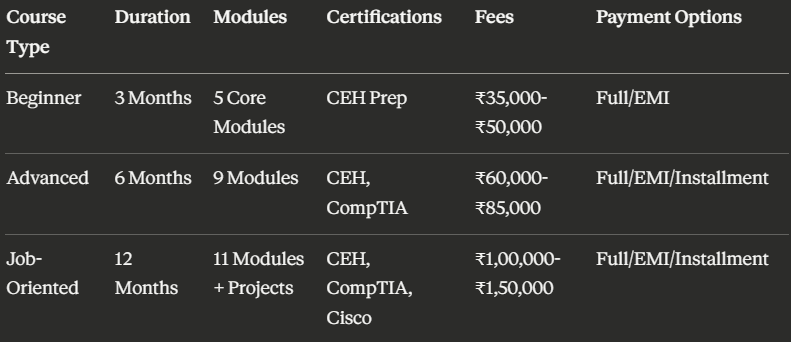
Beginner Course (3 Months) Ideal for those starting from fundamentals. Covers basic networking, Linux, Windows, and introductory ethical hacking. Fees typically range from ₹35,000 to ₹50,000.
Advanced Course (6 Months) Comprehensive training covering all modules from networking through incident response. Fees range from ₹60,000 to ₹85,000.
Job-Oriented Course (12 Months) Premium, intensive program with live projects, internships, and placement support. Fees range from ₹1,00,000 to ₹1,50,000.
Important: EMI and Installment Options Most reputable institutes offer flexible payment through installments or EMI options, making training accessible even if you can’t pay the full amount upfront. Monthly installments of ₹4,000-₹10,000 make premium training financially feasible.
Course Type Comparison Table
Consider this investment against the salary increase you’ll see in your first job — it typically pays for itself within 2–3 months of employment.
Salary Potential After Cyber Security Training
One of the most compelling reasons to pursue cyber security is the earning potential. Here’s what you can realistically expect:
Fresher Salaries (Immediately After Training) Entry-level positions like SOC Analyst or Junior Security Analyst typically offer ₹4–8 LPA (Lakhs Per Annum) depending on your institute’s reputation, interview performance, and the hiring company’s scale.
Experienced Salaries (After 3–5 Years) With relevant experience, your salary jumps to ₹10–18 LPA for mid-level roles like Security Analyst or Penetration Tester.
Senior Level Salaries (5+ Years Experience) Senior roles command ₹18–25 LPA or more. Specialized positions like Incident Response Manager, Cloud Security Architect, or Security Consultant can exceed ₹30 LPA.
Key Job Roles and Their Salary Ranges
SOC Analyst: ₹4–8 LPA (Entry Level), ₹8–12 LPA (Experienced) Monitors network security events and responds to alerts 24/7.
Security Analyst: ₹5–9 LPA (Entry), ₹10–16 LPA (Experienced) Assesses vulnerabilities and recommends security improvements.
Ethical Hacker / Penetration Tester: ₹6–10 LPA (Entry), ₹12–20 LPA (Experienced) Conducts authorized security testing and finds vulnerabilities.
Incident Responder: ₹7–11 LPA (Entry), ₹12–18 LPA (Experienced) Responds to security breaches and contains incidents.
Cloud Security Engineer: ₹8–12 LPA (Entry), ₹15–25 LPA (Experienced) Ensures security in cloud infrastructure and applications.
These salaries are substantially higher than many other technical fields, with faster growth trajectories. Your investment in training returns itself quickly through higher earning power.
Online vs Offline Cyber Security Training: Choosing Your Format
Different learning styles require different approaches. Understanding online versus offline training helps you choose what works best:
Offline Training Advantages
- Immediate access to experienced trainers for doubt resolution
- Hands-on lab experience in well-equipped centers
- Face-to-face networking with batch mates and instructors
- Regular accountability and structured learning pace
- Better for beginners needing guidance
Offline Training Challenges
- Location constraints — must travel to training center
- Fixed scheduling limits working professionals’ flexibility
- Higher costs due to infrastructure maintenance
Online Training Advantages
- Maximum flexibility — learn at your own pace
- Access from anywhere — ideal for working professionals
- Recorded sessions allow revisiting complex topics
- Often more affordable than offline programs
- Suitable for self-motivated learners
Online Training Challenges
- Requires self-discipline and consistent effort
- Lab access might be remote (less hands-on feel)
- Less networking and community interaction
- Difficult for complete beginners
Hybrid Learning (Best of Both) Many modern institutes offer hybrid models:
- Theory and lectures delivered online for flexibility
- Hands-on labs completed in-center for practical experience
- Weekend intensives for working professionals
- Recorded sessions for asynchronous learning
For most professionals in Delhi NCR, a hybrid or weekend offline model works best — combining theoretical flexibility with practical lab experience and networking opportunities.
What Makes EINITIAL24 Different: Why Students Choose Us
Thousands of institutes claim to offer cyber security training, but results vary dramatically. Here’s what makes EINITIAL24 stand out:
Expert Trainers with Real Industry Experience Our instructors aren’t just certified — they’re working or recently worked in cyber security roles. They bring real-world scenarios, current threat landscapes, and practical wisdom that transcends textbooks.
Hands-On Lab Environment Theory without practice creates incompetent professionals. Our state-of-the-art labs provide hands-on experience with industry tools and real-world scenarios mirroring actual security challenges.
Small Batch Sizes We maintain small batches (maximum 15–20 students per batch) ensuring personalized attention. This isn’t a mass production factory — you get individual guidance, doubt resolution, and mentorship.
Real Live Projects and Industry Simulations Learn by doing. Our curriculum includes live penetration testing projects, security audit simulations, and incident response scenarios mirroring real work.
Demonstrated Placement Record We don’t just promise placements — we deliver them. Our students consistently land positions at top companies with competitive packages. Check our website for actual graduate profiles and their current roles.
Flexible Training Schedules Weekday batches for dedicated learners, weekend batches for working professionals, evening programs for students, and online options for complete flexibility.
Career-Focused Approach Every module is designed with industry demand in mind. You learn what companies actually need, not just theoretical concepts.
Ongoing Alumni Support Job placement doesn’t end at training completion. We maintain an active alumni network, continue sharing job opportunities, and provide career guidance throughout your professional journey.
This comprehensive approach transforms ordinary people into capable cyber security professionals ready for real jobs and real challenges.
Real Student Success Stories
Nothing speaks louder than results. Here are examples of typical student transformations:
Raj Kumar — Software Engineer to Security Analyst Background: 2 years as software developer After EINITIAL24: Security Analyst at multinational corporation Salary Growth: ₹5.2 LPA → ₹8.5 LPA Timeline: Placed within 45 days of training completion
Priya Sharma — Career Changer Background: BBA graduate, no IT experience After EINITIAL24: SOC Analyst at leading IT services company Salary: ₹5.8 LPA Timeline: Placed within 60 days of training completion
Akshay Verma — Fresher Graduate Background: BTech Computer Science, fresh graduate After EINITIAL24: Junior Penetration Tester Salary: ₹6.5 LPA Timeline: Placed within 30 days of training completion
Neha Singh — Professional Upskilling Background: Network Administrator with 3 years experience After EINITIAL24: Senior Security Analyst Salary: ₹11.2 LPA (up from ₹6.5 LPA) Timeline: Promoted within 6 months of training completion
These are real transformations. People from different backgrounds, with varying experience levels, consistently land good-paying jobs after EINITIAL24 training.
Real Industry Projects Included in Training
You don’t just learn about cyber security — you do cyber security during your course. Here are examples of real projects:
VAPT (Vulnerability Assessment and Penetration Testing) Projects Conduct vulnerability assessments and penetration tests on sandbox environments mirroring real organization networks. Identify, document, and present findings exactly like professional testers do.
Security Audit Simulations Audit entire network segments for security compliance, document findings, and present reports with remediation recommendations.
Web Application Security Testing Test vulnerable web applications, identify OWASP Top 10 vulnerabilities, and document exploitation techniques and fixes.
SIEM Monitoring and Alert Creation Configure SIEM platforms, create detection rules, monitor security events, and respond to simulated incidents in real-time.
Threat Detection and Incident Response Labs Analyze system logs and network traffic to identify malware, data exfiltration, and unauthorized access attempts.
These aren’t theoretical exercises — they’re realistic scenarios building your portfolio and professional experience.
Career Opportunities After Cyber Security Training
Your career doesn’t end with job placement — it’s just the beginning. Cyber security offers diverse career paths and advancement opportunities:
Technical Career Track Progress from Security Analyst → Senior Security Analyst → Security Architect → Chief Information Security Officer (CISO). This track focuses on deepening technical expertise and managing security infrastructure.
Specialization Track Become a specialist in areas like:
- Cloud Security Engineering
- Threat Intelligence Analysis
- Incident Response and Forensics
- Application Security (AppSec)
- Security Operations Management
Management Track Move into leadership roles managing security teams, budgets, and enterprise-wide security programs.
Consulting Track Launch an independent consulting practice or join consulting firms, helping multiple organizations improve their security posture.
Government Track Work with government agencies, cyber security agencies, or law enforcement handling national-level cyber security challenges.
The beauty of cyber security is its depth and breadth — you can spend your entire career learning and growing without ever feeling stagnant.
How to Choose the Best Cyber Security Institute in Delhi
With multiple institutes offering cyber security training, choosing the right one determines your success. Here’s what to evaluate:
Trainer Experience and Credentials Verify trainers’ actual industry experience. Don’t just accept “10 years of experience” — ask what specific roles they held, what incidents they responded to, what companies they worked for. Work with trainers who’ve actually done the job.
Demonstrated Placement Record Ask for specific numbers: How many students last batch? How many got placed? What was the average salary? Best salary? Worst salary? Reputable institutes provide this transparency. Check if graduates work at companies you’d want to join.
Hands-On Labs and Equipment Visit the training center. See the labs yourself. Can students access equipment 24/7? Are tools current? Is there internet bandwidth for downloading large security tools? Poor labs signal a poor institute.
Certification Support Does the institute cover exam vouchers? Do they offer exam preparation? Will they pay for your exam if you don’t pass on the first attempt? Real commitment means financial support for certifications.
Student Reviews and Alumni Network Connect with past students. Browse genuine reviews on Google, LinkedIn, and education platforms. An active alumni network indicates strong post-training support.
Internship Opportunities Can they connect you with internships at real companies? This separates serious institutes from diploma mills. Real connections with hiring companies are a huge advantage.
Curriculum Alignment with Industry Does their curriculum match current job market demands? Is it updated regularly as threats and technologies evolve? Ask what changes they made in the last 6 months.
Interview Preparation Support How much time is dedicated to interview prep? Do they conduct mock interviews? Will they help with resume writing? Placement claims mean nothing without interview readiness.
Thoroughly evaluate these factors before committing — your training investment deserves a quality institute.
Frequently Asked Questions About Cyber Security Training
Q1: What are the minimum educational eligibility criteria?
Most cyber security courses require 12th pass minimum. Advanced courses prefer bachelor’s degree or 2+ years IT experience, but motivated 12th pass students can succeed in beginner programs.
Q2: Is a technical or coding background mandatory?
Absolutely not. While technical background helps, it’s not mandatory. Good institutes start from fundamentals. Logical thinking and commitment matter more than prior experience.
Q3: Are there age limits or admission restrictions?
No. Cyber security welcomes students from 18 to 65+ years. Career changers of any age find success. Motivation and dedication matter, not age.
Q4: Can working professionals join through weekend or evening batches? Yes. Reputable institutes specifically offer weekend, evening, and online batches for working professionals. You can train while continuing employment.
Q5: Is the course available online or in hybrid format?
Yes. Modern institutes offer purely online, purely offline, and hybrid options. Choose based on your learning style and schedule flexibility needs.
Q6: What subjects and modules does the curriculum cover?
Core modules include networking fundamentals, Linux/Windows security, ethical hacking, penetration testing, web security, SOC analyst training, SIEM tools, cloud security, malware analysis, live projects, and interview preparation.
Q7: Do you cover AI-driven cybersecurity tools?
Leading institutes increasingly include AI-driven security tools, threat detection automation, and machine learning basics as these are future security technologies.
Q8: Is training entirely practical or mostly theoretical?
Best institutes maintain 60–70% practical and 30–40% theory ratio. Theory without practice creates uninformed professionals; practice without theory creates reckless ones. Balance is crucial.
Q9: Are official certification exam vouchers included?
Quality institutes include official exam vouchers for major certifications like CEH, CompTIA Security+, and Cisco CyberOps in their fees.
Q10: What’s the total duration and weekly time commitment?
Beginner courses: 3 months, 6–8 hours/week. Advanced courses: 6 months, 10–12 hours/week. Intensive job-oriented: 12 months, 15–20 hours/week. Online courses offer flexibility to adjust timing.
Q11: What does “100% placement guarantee” really mean?
It means the institute commits to helping every qualified student find employment. It doesn’t mean they force jobs on you — it means continuous job opportunity updates, interview prep, and placement support until you secure a position.
Q12: What conditions must I meet to qualify for placements?
Typically: complete the full course with good attendance (75%+), pass all assessments, demonstrate competence in mock interviews, and actively participate in placement drives.
Q13: What’s the average and highest fresher salary?
Average fresher salary: ₹5–7 LPA. Highest salary achievable by top performers: ₹10–12 LPA. Salary depends on interview performance, company size, location, and specialization chosen.
Q14: Which top companies hire from institutes?
Reputable institutes attract interest from leading IT services companies, multinational corporations, startups, government agencies, and government enterprises. Specific companies depend on your batch’s performance and company hiring cycles.
Q15: Are mock interviews, resume building, and soft skills training included?
Quality institutes include comprehensive mock interview sessions, professional resume building guidance, LinkedIn optimization, and soft skills training covering communication, presentation, and professional etiquette.
Q16: What’s the total course fee and are installment options available? Fees range from ₹35,000 (beginner) to ₹1,50,000 (job-oriented 12-month). Most institutes offer flexible payment through installments (monthly EMI of ₹4,000-₹10,000) making training accessible.
Q17: Are there hidden charges for labs or study materials?
Transparent institutes clearly state all costs upfront. Watch for: hidden lab access fees, certification exam fees, study material charges, library fees, and placement assistance charges. Get everything in writing.
Q18: Where exactly in Delhi are training centers located?
Top institutes maintain multiple locations across Delhi including South Delhi, Rohini, Laxmi Nagar, Noida, and Gurgaon for accessibility. Choose locations convenient to your home or workplace.
Q19: Can I attend a free demo session before registration?
Reputable institutes enthusiastically offer free demo classes. Attend demos from multiple institutes before deciding. A good demo showcases teaching quality and course structure.
Q20: Do you offer remote lab access and data backup for home practice? Modern institutes provide VPN-based remote lab access allowing you to practice from home. Cloud-based lab environments with automatic data backup ensure you never lose your work.
Take Action Today: Your Cyber Security Journey Starts Now
The cyber security field waits for no one. Every day you delay, thousands of others are acquiring skills and landing high-paying jobs. The demand for professionals is extreme right now — but it won’t last forever as more people enter the field.
This is your moment. Here’s your next steps:
Book Your Free Demo Class Today Experience our training methodology firsthand. Meet our instructors. See our labs. Understand our approach. No obligation — just honest exposure to what we offer.
Download Our Complete Course Brochure Get detailed information about every module, certification, placement support, fees, and success stories. Make an informed decision with complete facts.
Talk to Our Career Counselor Discuss your background, goals, and concerns with our experienced career counselors. Get personalized guidance on which course matches your situation.
Register for Free Career Guidance Session Understand cyber security career paths, salary progression, job market dynamics, and how to position yourself for maximum opportunities.
Limited Seats Available Each training batch has limited seats to maintain quality and personalized attention. Premium batches fill up within weeks. Don’t wait — secure your spot now.
Conclusion: Your Future in Cyber Security
Cyber security represents more than just a job — it’s a career offering exceptional financial growth, job security, and the satisfaction of protecting organizations from evolving digital threats.
You’ve read about the demand, the salaries, the career growth, and the opportunities. You understand what you’ll learn and how it positions you for success. The only question remaining is: Will you take action?
EINITIAL24 is committed to transforming motivated individuals into capable, job-ready cyber security professionals. We combine expert instruction, hands-on training, live projects, and genuine placement support to ensure your success.
The cyber security profession needs people like you. Organizations desperately seek skilled professionals. The market pays premium salaries for expertise. All the conditions are perfect for your success.
Your journey from wherever you are now to becoming a confident, employed cyber security professional can start today. It takes commitment, the right training, and a quality institute that cares about your success.
Let EINITIAL24 be your partner in this transformation. Your future self will thank you for the decision you make today.
Ready to launch your cyber security career?
Book your free demo session now. The first step toward a better future is just one click away. Don’t let this opportunity pass — seats are limited, and serious students are already securing theirs.
Your cyber security career awaits. Make it happen today.




 English