

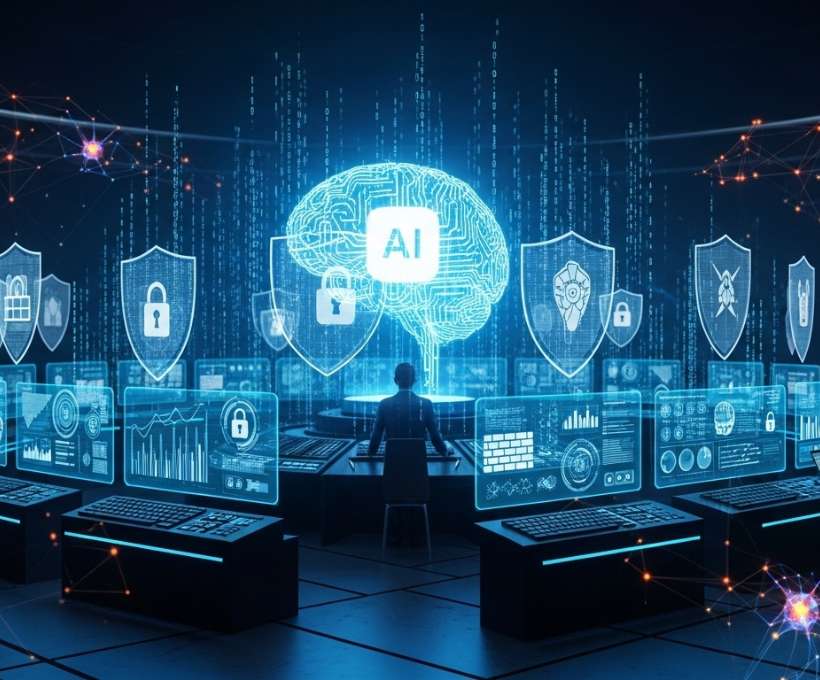
Cybersecurity has become one of the most critical challenges in the digital age. As businesses, governments, and individuals rely more heavily on connected systems, cyber threats have grown in complexity, scale, and frequency. Traditional security tools often struggle to keep up with sophisticated attackers who use automation, advanced malware, and constantly evolving tactics.
This is where Artificial Intelligence (AI) has started to transform the cybersecurity landscape. Instead of relying solely on predefined rules and manual monitoring, AI-powered systems can learn patterns, analyze massive volumes of data, detect anomalies, and respond to threats in real time.
The intersection of Artificial Intelligence and Cybersecurity is creating smarter, faster, and more adaptive defenses against cyberattacks. From identifying suspicious behavior to predicting future threats, AI is becoming an essential component of modern digital security.
In this blog, we will explore the top 10 uses of artificial intelligence in cybersecurity, explaining how AI strengthens security systems and helps organizations stay ahead of attackers.
1. Threat Detection and Prevention
One of the most important uses of AI in cybersecurity is advanced threat detection.
Traditional security tools rely on known threat signatures. If malware or attacks look slightly different from previously known patterns, they may go undetected. AI solves this problem by analyzing huge datasets and identifying unusual behaviors rather than just known signatures.
AI models monitor:
- Network traffic
- User activity
- Application behavior
- File access patterns
By using Machine Learning, AI systems can identify patterns that indicate malicious activity even if the attack has never been seen before.
For example, if an employee account suddenly downloads thousands of confidential files at midnight from a foreign IP address, AI systems can instantly flag the activity as suspicious.
This proactive detection helps organizations stop attacks before major damage occurs.
2. Malware Detection and Analysis
Malware continues to evolve rapidly, making traditional antivirus solutions less effective.
AI-powered cybersecurity systems analyze malware behavior instead of just scanning code signatures. This technique allows security systems to detect zero-day attacks and unknown malicious programs.
Using AI models trained on millions of malware samples, systems can identify suspicious features such as:
- Code execution patterns
- File behavior
- Network communication
- System resource usage
AI can even reverse-engineer malware automatically to understand its intent and origin.
This makes AI an extremely powerful tool against advanced threats like Ransomware, spyware, and botnets.
3. Phishing Detection
Phishing remains one of the most common cyber threats today. Attackers trick users into revealing sensitive information through fake emails, websites, or messages.
AI is highly effective at detecting phishing attempts because it can analyze both language patterns and technical signals.
AI-based phishing detection tools examine:
- Email text and tone
- Sender behavior
- Domain authenticity
- Link patterns
- Attachment characteristics
Using Natural Language Processing, AI can recognize suspicious language patterns often used in phishing messages.
For instance, an email that urges immediate action such as “verify your account now or it will be suspended” may trigger AI alerts.
Many modern email platforms like Google and Microsoft use AI to filter phishing emails automatically.
4. Behavioral Analytics and Insider Threat Detection
Not all cyber threats come from external hackers. Sometimes, security risks originate inside the organization.
Employees, contractors, or partners may intentionally or unintentionally expose sensitive data.
AI-powered behavioral analytics systems monitor how users interact with systems and detect abnormal activities.
For example, AI can identify when:
- An employee logs in from unusual locations
- Someone accesses files unrelated to their job role
- A user suddenly copies large volumes of sensitive data
These anomalies may indicate insider threats, compromised accounts, or unauthorized access.
By analyzing long-term patterns, AI can build behavioral profiles for each user and detect deviations instantly.
5. Automated Incident Response
When a cyberattack occurs, speed is critical. The longer a threat remains undetected, the greater the damage.
AI enables automated incident response, allowing systems to react immediately without waiting for human intervention.
Once AI detects suspicious activity, it can automatically:
- Isolate infected systems
- Block malicious IP addresses
- Disable compromised accounts
- Alert security teams
This automation dramatically reduces response time.
Many organizations now rely on Security Information and Event Management platforms enhanced with AI to coordinate automated responses to cyber incidents.
6. Vulnerability Management
Every software system contains vulnerabilities that attackers may exploit.
Identifying and fixing these weaknesses manually can be difficult because modern networks include thousands of devices and applications.
AI helps organizations identify vulnerabilities faster by:
- Scanning systems continuously
- Prioritizing high-risk vulnerabilities
- Predicting which flaws attackers are most likely to exploit
Using predictive analytics, AI can help security teams focus on the most dangerous vulnerabilities first.
This approach greatly improves risk management and reduces the likelihood of successful cyberattacks.
7. Fraud Detection
Financial institutions are among the biggest adopters of AI-powered cybersecurity tools.
Banks, payment platforms, and e-commerce companies use AI to detect fraudulent transactions in real time.
AI analyzes millions of transactions and identifies suspicious patterns such as:
- Unusual spending behavior
- Transactions from unknown locations
- Rapid purchases across multiple accounts
These systems are widely used by companies like PayPal and Visa to protect customers from financial fraud.
When suspicious activity is detected, AI systems can block transactions or request additional verification.
8. Security Operations Center (SOC) Enhancement
Security Operations Centers (SOCs) are responsible for monitoring and responding to cybersecurity incidents.
However, SOC teams often face alert fatigue due to the massive number of security alerts generated daily.
AI improves SOC efficiency by:
- Filtering false positives
- Prioritizing high-risk alerts
- Correlating multiple data sources
- Providing intelligent threat insights
This allows security analysts to focus on the most critical threats rather than wasting time on harmless alerts.
Many advanced SOC platforms integrate Deep Learning models to analyze complex threat patterns.
9. Bot and DDoS Attack Prevention
Bots and automated attack networks can overwhelm systems with traffic, causing service outages.
These attacks are known as **Distributed Denial-of-Service (DDoS) attacks.
AI-powered security tools can analyze traffic patterns and distinguish between legitimate users and malicious bots.
For example, AI can detect when:
- Thousands of requests originate from suspicious IP addresses
- Traffic spikes occur abnormally
- Bots attempt credential stuffing attacks
Once detected, AI systems can block malicious traffic before it disrupts services.
Major internet companies like Cloudflare rely heavily on AI to protect websites from DDoS attacks.
10. Predictive Cyber Threat Intelligence
One of the most exciting applications of AI in cybersecurity is predictive threat intelligence.
Instead of simply reacting to attacks, AI systems can predict potential cyber threats before they happen.
AI analyzes:
- Global threat databases
- Dark web activity
- Hacker forums
- Malware trends
By identifying emerging attack patterns, AI can warn organizations about potential threats.
Security teams can then strengthen defenses proactively rather than responding after damage occurs.
This predictive capability represents the future of cybersecurity.
Benefits of AI in Cybersecurity
Artificial intelligence provides several advantages that traditional security systems cannot match.
Faster Threat Detection
AI can analyze millions of events per second, allowing it to identify threats much faster than humans.
Improved Accuracy
Machine learning models reduce false positives and improve detection accuracy.
Automation
AI automates routine security tasks, freeing up cybersecurity professionals to focus on complex issues.
Scalability
AI systems can monitor large networks with thousands of devices without additional manpower.
Continuous Learning
AI improves over time as it learns from new threats and attack techniques.
Challenges of Using AI in Cybersecurity
Despite its advantages, AI also presents several challenges.
Adversarial AI
Hackers can use AI themselves to launch smarter attacks or trick security systems.
Data Quality Issues
AI models rely heavily on large datasets. Poor-quality data can lead to inaccurate predictions.
High Implementation Costs
AI-powered security solutions can be expensive to implement and maintain.
Skill Shortage
Organizations need skilled professionals who understand both cybersecurity and AI technologies.
The Future of AI in Cybersecurity
The role of AI in cybersecurity will continue to grow as digital systems become more complex.
Several emerging technologies will shape the future of AI-powered security:
- Autonomous security systems
- AI-powered deception technologies
- Self-healing networks
- Advanced threat prediction models
As cyberattacks become more sophisticated, AI will become an essential defense tool rather than an optional upgrade.
Experts believe the future of cybersecurity will rely heavily on the combination of human expertise and intelligent automation.
Conclusion
Cyber threats are evolving faster than ever before. Traditional security systems alone are no longer sufficient to defend modern digital infrastructures.
Artificial intelligence is transforming cybersecurity by enabling faster detection, smarter analysis, and automated responses to threats. From identifying malware to preventing fraud and predicting cyberattacks, AI is helping organizations stay one step ahead of cybercriminals.
The integration of Artificial Intelligence and cybersecurity represents one of the most powerful technological partnerships of the digital era. While challenges still exist, the benefits far outweigh the risks.
As organizations continue to adopt AI-powered security solutions, the future of cybersecurity will become more proactive, intelligent, and resilient.
In a world where data is one of the most valuable assets, AI-driven cybersecurity will play a crucial role in protecting digital ecosystems for years to come.



 English