

Cybersecurity is no longer optional.
It is no longer niche.
And it is definitely no longer slow-moving.
In 2026, organizations across the globe are facing an explosion of cyber threats—ransomware-as-a-service, AI-powered phishing, insider attacks, cloud breaches, and supply chain compromises. At the center of this battlefield stands one role that never sleeps:
The SOC Analyst.
If you are considering a career in cybersecurity, transitioning from IT, or upskilling to stay relevant in 2026, becoming a Security Operations Center (SOC) Analyst is one of the smartest career decisions you can make.
This guide is not theory-heavy or unrealistic.
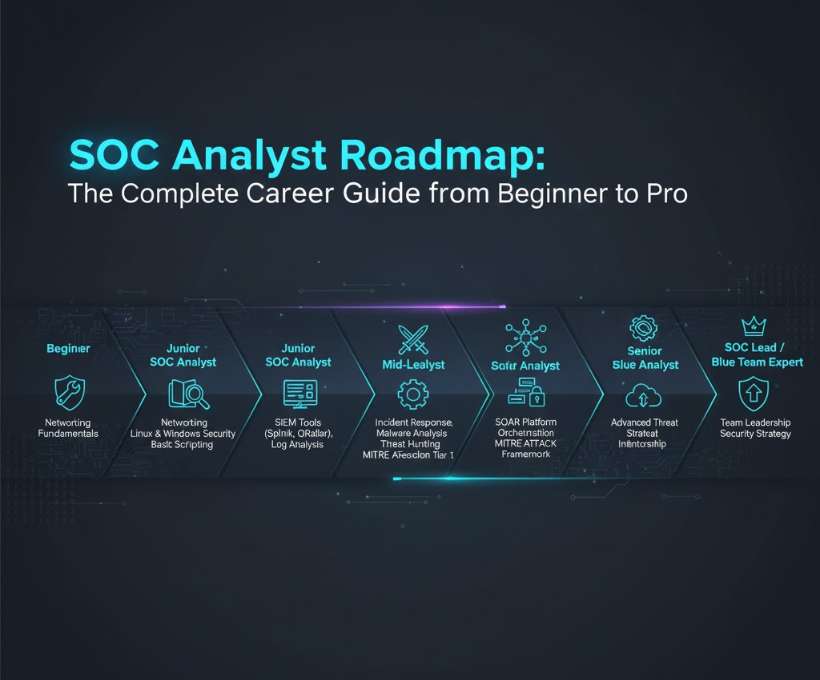
This is a real-world SOC Analyst Roadmap for 2026, designed for beginners, students, working professionals, and career switchers—step by step.
And throughout this roadmap, you will see how EINITIAL24 helps bridge the gap between learning and real SOC work.
What Is a SOC Analyst in 2026?
A SOC Analyst is the frontline defender of an organization’s digital infrastructure.
In simple terms, SOC Analysts:
- Monitor security alerts
- Investigate suspicious activity
- Respond to cyber incidents
- Protect systems, networks, cloud environments, and data
- Work 24/7 to stop attacks before damage occurs
But in 2026, the role has evolved.
SOC Analysts today are no longer just alert watchers.
They are:
- Threat hunters
- Incident responders
- Cloud security defenders
- SIEM specialists
- Automation-aware analysts
Modern SOCs are fast, noisy, and data-heavy.
Only trained professionals survive and thrive.
Why SOC Analyst Is a Top Career Choice in 2026
Let’s talk reality.
1. Massive Global Demand
Every organization needs security monitoring—banks, hospitals, startups, governments, SaaS companies, and cloud providers.
There is a global shortage of skilled SOC professionals, and that gap is widening in 2026.
2. Strong Salary Growth
Entry-level SOC Analysts already earn competitive salaries.
With experience, certifications, and hands-on skills, compensation rises quickly.
3. Career Flexibility
SOC Analyst is not a dead-end role.
From SOC, you can move into:
- Threat Intelligence
- Incident Response
- Cloud Security
- Detection Engineering
- Red Teaming
- Security Architecture
4. No Coding Degree Required
You do not need to be a software engineer.
You need:
- Curiosity
- Analytical thinking
- Structured training
- Hands-on practice
That is where the right roadmap matters.
SOC Analyst Levels Explained (2026 Career Path)
Before diving into skills, you must understand the SOC hierarchy.
SOC Level 1 (L1): Junior SOC Analyst
This is the entry point.
Responsibilities include:
- Monitoring SIEM alerts
- Triage of security events
- Basic investigation
- Escalating incidents
- Following playbooks
This is where most beginners start.
SOC Level 2 (L2): Intermediate Analyst
At this level, analysts:
- Perform deeper investigations
- Correlate logs across systems
- Handle malware analysis basics
- Support incident response
- Tune alerts
SOC Level 3 (L3): Senior Analyst
Senior analysts:
- Lead investigations
- Handle advanced threats
- Create detection rules
- Mentor junior analysts
- Coordinate incident response
Beyond SOC
With experience, you can move into:
- Threat Hunting
- DFIR (Digital Forensics & Incident Response)
- Detection Engineering
- SOC Manager roles
SOC Analyst Roadmap 2026: Step-by-Step
Let’s break this roadmap into clear stages.
No confusion.
No unrealistic expectations.
Stage 1: Build Strong IT & Networking Foundations
Before security, you must understand how systems work.
This is non-negotiable.
Core Concepts You Must Learn
- TCP/IP fundamentals
- OSI Model
- DNS, DHCP, HTTP/HTTPS
- Firewalls and proxies
- VPNs
- Basic Linux and Windows internals
- Active Directory fundamentals
You are not memorizing.
You are understanding how data flows.
At EINITIAL24, these fundamentals are taught from a SOC perspective, not generic IT theory—so learners understand why it matters in real attacks.
Stage 2: Learn Operating Systems Like an Analyst
SOC Analysts live inside operating systems.
Windows Skills for SOC Analysts
- Event Viewer
- Windows logs (Security, System, Application)
- PowerShell basics
- User and group management
- Registry awareness
- Common attack techniques on Windows
Linux Skills for SOC Analysts
- Log files (/var/log)
- Bash basics
- File permissions
- Process monitoring
- SSH activity
- Cron jobs
In 2026, attackers target misconfigurations, not just vulnerabilities.
SOC Analysts must see what others miss.
Stage 3: Cybersecurity Fundamentals (The Core Layer)
Now you step into security-specific knowledge.
Key Topics You Must Master
- CIA Triad (Confidentiality, Integrity, Availability)
- Threats vs vulnerabilities vs risks
- Malware types
- Phishing attacks
- Brute-force attacks
- MITRE ATT&CK framework
- Kill chain concepts
- Security controls (preventive, detective, corrective)
This stage builds your security mindset.
At EINITIAL24, this phase is reinforced using real attack case studies, not textbook definitions.
Stage 4: SIEM Tools – The Heart of SOC
If you want to work in SOC, you must understand SIEM.
What SIEM Does
- Collects logs
- Correlates events
- Generates alerts
- Supports investigations
Popular SIEM Tools in 2026
- Splunk
- Microsoft Sentinel
- QRadar
- Elastic SIEM
- Sumo Logic
You do not need to master all—but you must understand SIEM logic.
Key skills include:
- Log analysis
- Correlation rules
- Alert triage
- False positive identification
- Dashboard interpretation
EINITIAL24 emphasizes hands-on SIEM labs, because SOC hiring managers look for experience—not just tool names.
Stage 5: Incident Detection & Response
This is where you stop being a learner and start thinking like a defender.
Incident Types You Must Handle
- Phishing incidents
- Malware infections
- Brute-force attacks
- Account compromise
- Insider threats
- Data exfiltration
- Ransomware attempts
You learn:
- How to investigate alerts
- How to validate threats
- How to document incidents
- How to escalate correctly
- How to respond without panic
In 2026, speed and accuracy matter more than ever.
Stage 6: Cloud Security Awareness (Mandatory in 2026)
Cloud is no longer optional.
SOC Analysts in 2026 must understand:
- AWS basics
- Azure security concepts
- Cloud logs
- IAM risks
- Misconfigured storage
- Cloud attack patterns
Even entry-level SOC roles now expect cloud exposure.
EINITIAL24 integrates cloud security fundamentals directly into SOC training—aligning with real-world job expectations.
Stage 7: Threat Intelligence & MITRE ATT&CK
Modern SOCs do not just react.
They anticipate.
Threat Intelligence Skills
- Understanding threat actors
- TTPs (Tactics, Techniques, Procedures)
- Mapping alerts to MITRE ATT&CK
- Using intelligence feeds
- Contextualizing alerts
This transforms you from an alert handler into a thinking analyst.
Stage 8: Automation & AI Awareness
SOC in 2026 is faster, smarter, and partially automated.
You do not need to be a developer—but you must understand:
- SOAR basics
- Playbooks
- Automation workflows
- AI-assisted detection
- Alert prioritization using ML
This keeps SOC analysts relevant—not replaced.
Certifications That Matter in 2026
Certifications support your skills—not replace them.
Recommended certifications:
- CompTIA Security+
- Blue Team Level 1 (BTL1)
- SOC-focused vendor certs
- Cloud security fundamentals
EINITIAL24 aligns training content with certification objectives while prioritizing practical skill development.
Common Mistakes SOC Aspirants Make
Let’s be honest.
Many fail because they:
- Skip fundamentals
- Chase too many tools
- Avoid hands-on labs
- Memorize instead of practice
- Rely only on theory
SOC is not about knowing everything.
It is about knowing how to investigate.
How EINITIAL24 Helps You Become Job-Ready
This is where roadmap meets execution.
EINITIAL24 is not generic cybersecurity training.
It is designed specifically for:
- SOC Analyst roles
- Real-world scenarios
- Practical investigations
- Industry-aligned skills
What Makes EINITIAL24 Different
- SOC-focused curriculum
- Hands-on labs and simulations
- Real incident case studies
- Beginner-friendly approach
- Career-oriented training
- Updated content for 2026 threats
EINITIAL24 bridges the gap between learning cybersecurity and working in a SOC.
Who Should Follow This SOC Analyst Roadmap?
This roadmap is ideal for:
- Students and fresh graduates
- IT support professionals
- Network engineers
- Career switchers
- Cybersecurity beginners
- Professionals aiming for SOC roles
You do not need perfection.
You need direction, discipline, and the right training partner.
Final Thoughts: SOC Analyst in 2026 Is a Career, Not Just a Job
SOC Analysts are the guardians of the digital world.
In 2026, this role demands:
- Skill
- Awareness
- Adaptability
- Continuous learning
But for those willing to commit, the rewards are real—career stability, growth, and purpose.
With the right roadmap and structured training from EINITIAL24, you are not just preparing for a job.
You are preparing for a future-proof cybersecurity career.
Ready to Start Your SOC Analyst Journey?
If you are serious about becoming a SOC Analyst in 2026, do not rely on scattered resources or outdated content.
Choose structured learning.
Choose hands-on experience.
Choose EINITIAL24.
Your SOC career starts with the right roadmap—and the right training.




 English