

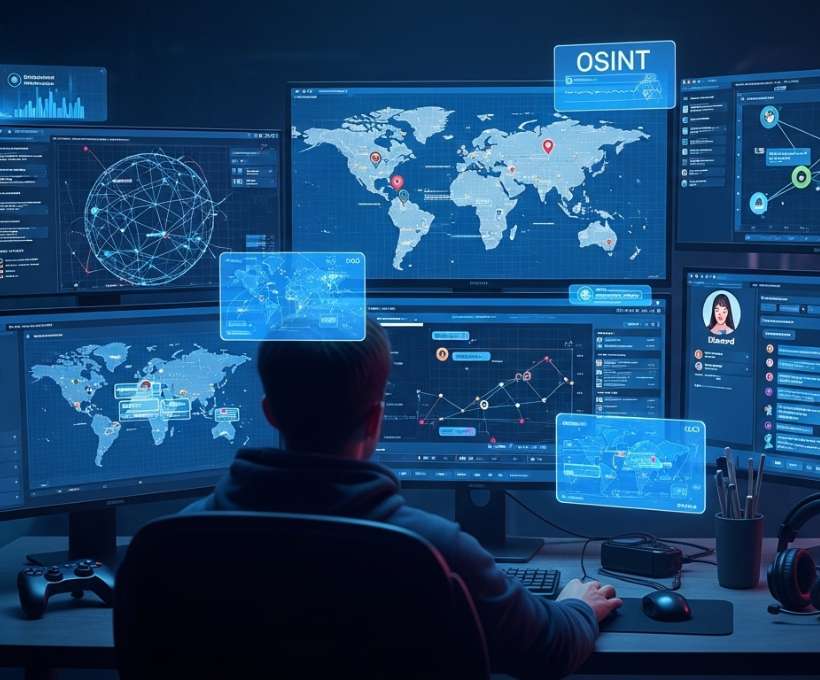
OSINT Games: Techniques and Tools You Need to Know
OSINT games have become one of the most practical and engaging ways to learn open-source intelligence. They turn research, verification, and digital detective work into a challenge. Instead of reading theory alone, you solve puzzles, follow digital breadcrumbs, and learn how real investigators think.
At their best, OSINT games build genuine skill. They train you to look carefully, connect details across platforms, and verify information instead of assuming it. That is why they are popular with cybersecurity learners, analysts, journalists, investigators, and anyone curious about how public data can be used responsibly.
They also feel surprisingly human. Each challenge usually tells a story. A username appears in one place, a photo hides a clue in another, and a small detail in a game profile may reveal the final answer. That sense of discovery is what makes OSINT games so effective.
For learners, this is more than entertainment. It is a low-risk way to practice the same habits that matter in professional OSINT, digital investigations, due diligence, fraud detection, threat intelligence, brand research, and security awareness.
At EINITIAL24, we see OSINT games as an excellent bridge between learning and application. They are valuable for training sessions, hands-on workshops, service delivery, and product development because they teach people how to think, not just what to search.
What Are OSINT Games?
OSINT games are challenge-based exercises built around public information. They may ask you to identify a person, a place, an account, an event, a game item, or a hidden clue using open sources only.
These games can be simple, like finding a username across platforms, or advanced, like reconstructing a timeline from screenshots, metadata, social profiles, map clues, and forum activity. Many of them are designed like puzzles or Capture The Flag challenges, where the goal is to find a final flag, code, or answer.
The strength of OSINT games is that they teach process. You learn how to search more effectively, compare sources, validate findings, and avoid false positives. That is exactly the mindset needed in real investigations.
They also reward creativity. Sometimes the answer is hidden in plain sight. Sometimes a profile picture, a nickname, or a Discord message becomes the key. This is why OSINT games are so useful for beginners and experienced practitioners alike.
Why OSINT Games Matter
OSINT skills are increasingly important in a world full of public data. Every profile, post, image, username, and comment can become a clue if you know how to examine it carefully.
OSINT games matter because they make this learning practical. You do not just memorize definitions. You practice real workflows. You discover how to pivot from one clue to another, how to check consistency, and how to distinguish signal from noise.
They also improve critical thinking. Good OSINT is not about collecting random data. It is about asking the right questions, narrowing the search, and building evidence step by step.
For organizations, this matters too. Teams that understand OSINT are better at research, trust and safety, cyber threat awareness, brand monitoring, and public risk analysis. That is one reason EINITIAL24 offers OSINT training, workshop formats, and service support for teams that want practical capability, not just theory.
OSINT Games: Techniques and Tools
Below are the core methods that appear again and again in OSINT games. These techniques are useful in beginner puzzles, intermediate CTFs, and advanced investigative exercises.
1. Username Pivoting
Username pivoting is one of the most common and powerful OSINT techniques.
It starts with a single username, handle, alias, or gamer tag. From there, you search for the same or similar identifier across multiple platforms. A person may use one name on Reddit, another on GitHub, and the same variation on Discord, Steam, X, Instagram, or a gaming forum.
The value of username pivoting is consistency. People often reuse usernames. Even when the exact spelling changes, patterns usually remain. A suffix, a number, or an old nickname can connect accounts that look unrelated at first glance.
In OSINT games, username pivoting often reveals profile links, bios, comment history, profile images, or linked communities. These details can expose interests, regions, time zones, language patterns, and behavioral habits.
Good tools for this include username search engines, platform search bars, general web search, and manual cross-checking. The most important skill is patience. The first result is not always the right one. The best investigator tests variations and verifies before concluding.
2. Cross-Platform Correlation
Cross-platform correlation means connecting evidence from different sites or services to build a stronger picture.
A single source may be misleading. Two or three sources that agree with each other become much more useful. In OSINT games, you might find a username on one platform, an image on another, and a location clue on a third. When those clues align, the answer becomes much more reliable.
This technique also helps avoid false positives. Many people share the same name, same game tag, or same avatar style. Cross-platform correlation gives you context. It helps you determine whether the account you found is the right one.
Strong OSINT work is rarely based on one clue alone. It is built on patterns. Language, posting time, photo style, gaming interests, linked communities, and repeated usernames all contribute to the final judgment.
This is where disciplined verification matters. The more you can correlate independently, the more defensible your conclusion becomes.
3. In-Game Intelligence
In-game intelligence refers to clues hidden inside the game itself or related gaming ecosystems.
Sometimes the target is not outside the game at all. The game profile, leaderboard, match history, clan tag, mod list, skin selection, achievements, chat logs, or user-generated content may contain the exact clue you need.
OSINT games often use gaming platforms because they are rich with public behavior. Players leave traces in friend lists, team names, patch notes, community posts, tournaments, and forum discussions. Even a small detail, such as a repeated squad name or a favorite map, can help narrow the search.
In-game intelligence is especially useful when learning how digital identity works. People behave differently in gaming spaces than on professional social media. That can reveal interests, habits, schedule patterns, or social connections.
A careful investigator reads the game environment like a map. The clue may not be the obvious one. It may be hidden in a nickname, a banner, a screenshot, or a timestamp.
4. Visualization Tools
Visualization tools make OSINT easier to understand and explain.
Instead of staring at dozens of links, names, and timestamps, you can map relationships visually. Graphs, timelines, tables, and network diagrams make patterns obvious. They also help teams communicate findings more clearly.
In OSINT games, visualization is useful for showing how one username connects to multiple accounts, how one photo leads to multiple clues, or how a timeline of posts fits together. It makes evidence easier to review and present.
Visualization is not only about aesthetics. It is about reducing cognitive load. When the number of clues grows, visual structure helps you avoid confusion and see what matters.
Common visualization approaches include relationship mapping, geolocation plotting, timeline building, spreadsheet clustering, and link analysis. These methods are especially useful in workshops and training programs because they turn scattered clues into a coherent story.
At EINITIAL24, we often encourage learners and teams to treat visualization as part of the investigation workflow, not an afterthought. It improves both accuracy and presentation quality.
And Don’t Forget Discord OSINT
Discord OSINT deserves special attention because Discord has become a major social and gaming platform.
Many people treat Discord as private, but public servers, shared invite links, profile details, usernames, server nicknames, status messages, and linked accounts can still provide clues. In OSINT games, Discord is often used as a clue source because users reveal activity, interests, community membership, and sometimes cross-platform links.
Discord OSINT may involve checking server names, examining message patterns, identifying common invite structures, or connecting a Discord identity to other public profiles. In gaming-related challenges, it is often one of the richest places to find context.
It is important to use Discord OSINT ethically and legally. The goal is to analyze public or permitted information, not to invade private spaces. Good OSINT respects boundaries and follows the rules of the platform and the challenge.
For modern OSINT learners, Discord is essential. If you understand Discord well, you understand a major part of today’s digital social graph.
A Practical OSINT Games Workflow
A good OSINT workflow keeps you organized and reduces mistakes.
Start with the clue you already have. It may be a username, a screenshot, a profile, a game character name, or a short text fragment. Then search broadly, but do not stop there. Pivot from the first result into other platforms and compare the evidence.
Next, document everything. Record the source, the date, the clue, and why it matters. In OSINT games, documentation is often the difference between a lucky guess and a repeatable method.
Then verify. Check whether the clue is consistent across sources. Ask whether the result fits the context, the language, the location, the platform behavior, and the timeline.
Finally, synthesize. Put the clues together into a short explanation. This habit is essential in professional environments and extremely valuable for portfolios, interviews, and assessments.
Tools Commonly Used in OSINT Games
OSINT games do not require a huge toolkit, but the right tools make the process much smoother.
Search engines remain the foundation. General web search, image search, and platform-specific search are still the first layer of discovery. Advanced operators can narrow results and reduce noise.
Image tools are also important. Reverse image search, screenshot inspection, metadata checking, and visual comparison are common in geolocation and profile analysis tasks.
Spreadsheet tools are helpful for organizing usernames, timestamps, links, and clues. A clean table can quickly reveal patterns that are not visible in raw notes.
Mapping and visualization tools help with geolocation and timeline tasks. They are useful when a challenge requires you to connect places, movement, and time.
Browser extensions, note-taking tools, and archive services can also help. The exact stack depends on the challenge, but the real advantage comes from method, not software alone.
For learners and teams, EINITIAL24 can support tool selection, training design, and workshop workflows so that people learn an efficient and repeatable investigation process.
OSINT Games and Real-World Careers
OSINT games are not just a pastime. They can support real careers.
Cybersecurity teams value people who can investigate carefully and validate findings. Intelligence analysts rely on structured research. Journalists use open-source evidence to confirm stories. Fraud and risk teams look for patterns across public data. Brand and marketing teams may use OSINT to understand communities, trends, and reputation.
The strongest benefit of OSINT games is that they show your thinking process. A finished challenge can demonstrate persistence, logic, verification, and attention to detail. That is highly attractive to employers and clients.
They also help you build a portfolio. A well-documented challenge write-up, a geolocation breakdown, or a username pivot case study can show real skill in a way that a certificate alone cannot.
If your goal is to build professional capability, not just hobby knowledge, OSINT games are a smart place to start. That is one reason companies like EINITIAL24 invest in training, workshop delivery, and product development around practical OSINT learning.
How OSINT Games Help Beginners
Beginners often feel overwhelmed by OSINT because there are so many tools and so much public data. OSINT games solve that problem by giving structure.
Instead of asking a beginner to “research anything,” a game gives a clear target and a finite goal. That makes learning manageable. Each round teaches a specific lesson, such as finding a username, interpreting an image, or checking a Discord profile.
Beginners also benefit from immediate feedback. If they solve the challenge, they know the process worked. If they fail, they can review where the logic broke down.
This is a better learning model than passive reading. It is active, repeatable, and measurable.
Geolocation in OSINT Games
Geolocation is one of the most exciting parts of OSINT games.
It involves identifying a place from visual clues, signage, architecture, terrain, road markings, shadows, vegetation, language, and contextual hints. A single screenshot may contain enough information to narrow the location dramatically.
Geolocation teaches observation. You learn to notice what others miss. A shop sign, a road direction, a bus logo, or even the shape of a mountain can matter.
The key is to work carefully. Many clues seem obvious but are actually misleading. Good geolocation combines visual analysis, map comparison, street-level checking, and local context.
It is also one of the best ways to practice evidence discipline. You need to show how you got from the image to the conclusion, not just state the answer.
What Is an OSINT CTF?
An OSINT CTF is a Capture The Flag challenge focused on open-source intelligence.
Like other CTFs, the goal is to solve a series of tasks and collect flags or answers. But instead of exploiting code or systems, you use research, analysis, and verification skills.
OSINT CTFs may include social media analysis, geolocation, username hunting, metadata examination, archive research, or reconnection of clues across platforms. They are often used by training communities, cybersecurity learners, and professional development programs.
They are valuable because they are realistic without being dangerous. You can practice serious skills in a safe environment.
What Is the OSINT Dojo?
The OSINT Dojo is commonly understood as a hands-on learning environment or practice space for OSINT skills.
In many communities, “dojo” refers to structured practice, repetition, and guided skill building. That is exactly what OSINT learners need. A dojo-style format usually combines challenges, walkthroughs, and active practice.
The benefit of this approach is consistency. Rather than only solving isolated puzzles, learners build a routine. They improve faster because they practice core methods repeatedly.
Trace Labs and Real-World Investigation
Trace Labs is often discussed in the OSINT world because it connects public-source investigation with real-world missing persons work.
This makes it different from a pure game. The skills are similar, but the context is more serious. Participants use OSINT methods to support real humanitarian efforts and investigative work.
So is it a game or a real-world investigation? In practice, it can look like both. The activity may have challenge-like structure, but the purpose and impact are real.
That distinction matters. It reminds learners that OSINT skills are powerful and should be applied responsibly.
Sofia Santos (Gralhix) OSINT Exercises
Sofia Santos, also known as Gralhix in the OSINT community, is associated with practical OSINT learning content and exercises.
These exercises are well known because they encourage hands-on investigation, verification, and structured reasoning. They are especially useful for people who want to improve beyond theory and begin solving real-looking problems.
Exercises like these are valuable because they often reflect the complexity of actual investigations. They force learners to connect multiple sources, work methodically, and explain their reasoning.
Are There Any OSINT Board Games?
Yes, the idea of OSINT board games exists in concept and in some community formats.
These are usually designed to teach investigative thinking, clue chaining, and source evaluation in a more physical or collaborative environment. They may not be as common as digital OSINT games, but the idea is appealing for classrooms, workshops, and team training.
Board-game style exercises can be especially useful for training groups that benefit from discussion, shared reasoning, and live collaboration.
How to Document Your OSINT Game Progress for a Portfolio
Documentation is one of the most underrated parts of OSINT learning.
A strong portfolio should show more than the answer. It should show the path. Include the starting clue, the steps you took, the sources you checked, the dead ends you ruled out, and the evidence that supported the final conclusion.
Screenshots, short notes, and a clean conclusion make your work easier to review. Keep your writing clear and professional. Avoid overclaiming. State what you know, what you inferred, and what remains uncertain.
A portfolio with good methodology can be more valuable than a portfolio with many incomplete answers. Employers and clients want to see how you think.
This is also where EINITIAL24 can help through training and workshop support. We help individuals and teams build documentation habits that are useful for portfolios, assessments, and real-world reporting.
Why EINITIAL24 Is a Strong Fit for OSINT Training, Workshops, Services, and Product Development
OSINT is a skill set, but it is also a process that can be taught, scaled, and operationalized.
At EINITIAL24, we focus on practical capability. That means training that actually builds research skill, workshops that create hands-on learning, services that support real use cases, and product development that helps teams work faster and smarter.
For individuals, this may mean beginner-friendly OSINT training or advanced challenge-based learning. For organizations, it may mean custom workshops, internal capability building, or OSINT workflow design.
For product development, it may mean building tools, learning assets, templates, or internal systems that make OSINT easier to use at scale.
The point is simple: OSINT should not stay trapped in theory. It should become a usable skill set. That is the space where EINITIAL24 adds value.
FAQs About OSINT Games
What are OSINT games?
OSINT games are challenge-based exercises that teach open-source intelligence through public clues, research, verification, and analysis.
Are OSINT games free to play?
Many are free, especially community challenges, learning rooms, and public CTF-style exercises. Some platforms or premium training environments may require payment.
What is the best OSINT game for beginners?
The best beginner game is one with clear instructions, smaller clues, and a guided learning path. Beginner-friendly OSINT rooms on training platforms are usually the easiest place to start.
How do OSINT games help in real-world careers?
They build research discipline, verification habits, pattern recognition, documentation skills, and reporting confidence. These are useful in cybersecurity, intelligence, journalism, risk, and investigations.
What is an OSINT CTF (Capture The Flag)?
An OSINT CTF is a puzzle or challenge event where you solve open-source intelligence tasks to find answers or flags using public information only.
What are the most common tasks in OSINT challenges?
Common tasks include username searches, image analysis, geolocation, social media correlation, timeline building, and source verification.
What tools do I need to play OSINT games?
You usually need search engines, reverse image search, note-taking tools, spreadsheets, mapping tools, and patience. Advanced tools are helpful, but not always necessary.
What is “Google Dorking” in OSINT games?
Google Dorking is the use of advanced search operators to find specific information more efficiently. It helps narrow search results and uncover hidden or indexed details.
Can I play OSINT games without coding skills?
Yes. Most OSINT games do not require coding. Strong observation, search discipline, and logic matter more than programming.
How do I practice geolocation for OSINT?
Practice by analyzing images, comparing landmarks, checking maps, studying road signs, and reviewing geolocation walkthroughs from trusted learning communities.
What are the best TryHackMe OSINT rooms?
TryHackMe changes over time, so the best rooms depend on current availability and your skill level. Look for OSINT-focused rooms with image analysis, profiling, and geolocation tasks.
Is Trace Labs a game or real-world investigation?
It has game-like structure, but it supports real-world humanitarian investigation work. That makes it more than a simple game.
What are the Sofia Santos (Gralhix) OSINT exercises?
They are practical OSINT learning exercises that help people build investigative reasoning through hands-on challenges and structured analysis.
Are there any OSINT board games?
Yes, some community learning formats use board-game style approaches to teach clue solving, teamwork, and intelligence thinking.
What is the OSINT Dojo?
The OSINT Dojo usually refers to a practice-oriented learning space or approach focused on repeated, hands-on OSINT training.
How do I find professional OSINT CTF events?
Look at cybersecurity communities, OSINT training groups, conference agendas, investigation communities, and professional learning platforms that host challenge events.
What is a “sock puppet” account in OSINT games?
A sock puppet account is a fabricated or alternate online identity used for investigation, testing, or controlled interaction. It should be used carefully and ethically.
Are OSINT games legal to play?
Yes, when they are played within the rules of the challenge and using public or permitted information. You should never access private data without authorization.
What is the difference between GEOINT and OSINT games?
OSINT games use public information broadly, while GEOINT focuses specifically on geographic or location-based intelligence. GEOINT is often a subset or specialization within OSINT-style work.
How can I document my OSINT game progress for a portfolio?
Save your clues, explain your steps, include screenshots where appropriate, and write a short conclusion that shows how you reached the answer. Good documentation is often more valuable than a lucky solve.
Final Thoughts
OSINT games are one of the smartest ways to learn open-source intelligence because they combine practice, problem-solving, and evidence-based thinking. They are engaging for beginners, useful for professionals, and flexible enough to support training, workshops, and internal capability building.
If you want to build a practical OSINT learning path, create an internal training program, run a workshop, or develop a custom OSINT product for your team, EINITIAL24 is positioned to help with all four: training, workshops, services, and product development.
The more you practice, the better your instincts become. That is the real value of OSINT games. They train you to notice, connect, verify, and explain.



 English